 KAS (KAS)
- 62مؤشر المعنويات الاجتماعية (SSI)+2.73% (24h)
- #107ترتيب اتجاه السوق (MPR)+24
- 17الانتشار الاجتماعي 24 سا+6.25% (24h)
- 53%نسبة KOL الصاعدة خلال 24 ساعة9 مؤثر KOL نشط
- ملخصKAS social hotness up 2.7%, community active, large whale address appears, DeFi development advancing, price slightly down 1.4%.
- إشارات صعود
- Community enthusiasm high
- Large whale holdings increase
- DeFi AMM whitepaper released
- KOL anticipates Elon echo
- Design animation showcases progress
- إشارات هبوط
- Price down 1.4%
- Regulatory environment unclear
- Large whales may sell
- Media hype high risk
- Trading volume information missing
مؤشر المعنويات الاجتماعية (SSI)
- البيانات الإجمالية62SSI
- اتجاه SSI (7ي)السعر (7 أيام)توزيع المشاعرمتصاعد بقوة (24%)صاعد (29%)محايد (41%)هابط (6%)رؤى SSIKAS social hotness is moderate (62/100, +2.7%), driven by community activity up 19.4% and KOL attention up 15.8%, sentiment down 18% possibly due to price pullback.
ترتيب اتجاه السوق (MPR)
- منبه الرؤىKAS warning rank rose to #107 (+24), social anomaly increased 113% to 45.3/100 significantly, sentiment polarization decreased, linked to recent large whale entry and DeFi development progress.
منشورات X
 coinco DeFi_Expert Media B7.29K @coinco041
 Zealous Swap D6.91K @ZealousSwap
The ZealousSwap CoAMM whitepaper is out. A full constant-product AMM built in Kaspa L1 covenants, no smart-contract VM, documented end to end: swaps, liquidity, fees, and single-transaction token-to-token routing. Running on testnet-10 now. https://t.co/XGJQD5lxST
55 2 884 أصلي >اتجاه KAS بعد الإصدارمحايدKAS testnet releases ZealousSwap CoAMM whitepaper Classic Founder Researcher B3.35K @ClassicxbtZealous Swap D6.91K @ZealousSwap
The ZealousSwap CoAMM whitepaper is out. A full constant-product AMM built in Kaspa L1 covenants, no smart-contract VM, documented end to end: swaps, liquidity, fees, and single-transaction token-to-token routing. Running on testnet-10 now. https://t.co/XGJQD5lxST
55 2 884 أصلي >اتجاه KAS بعد الإصدارمحايدZealousSwap whitepaper released on Kaspa, testnet launched- Classic Founder Researcher B3.35K @Classicxbt
 KaChat D1.37K @KaChat_
$KAS KaChat 2.0 Version 11 for Android is now out! What it should fix: Connection issues Sending replies, audios, or photos should never be base64 text If base64 test does appear the entire text should no longer generate within your chat and instead have a "show more" option Start testing here - https://t.co/dTqgY8rnIc
17 0 339 أصلي >اتجاه KAS بعد الإصدارمحايدKAS releases KaChat version 2.0, fixing connection and media sending issues - Classic Founder Researcher B3.35K @Classicxbt
 Crypto Matt ꓘ D3.53K @cryptomatt1983
Vote Kaspa $KAS More coverage, exposure and content on KASPA from larger YouTubers. Share. https://t.co/CbfcDI12z2
81 2 7.45K أصلي >اتجاه KAS بعد الإصدارصاعدEncourage voting for Kaspa, expecting increased attention  jules.kas Influencer Researcher A2.01K @Julian4crypto
GM Happy Friday ☕️☀️ Wishing you a blessed weekend kaspa:native bittensor:native crypto friends https://t.co/lFC60fX6UR
 11 1 272 أصلي >اتجاه KAS بعد الإصدارمحايدThe tweet greets the cryptocurrency community, mentions KAS and TAO, and wishes a happy weekend.
 Justin Bons Founder FA_Analyst B66.03K @Justin_Bons
 onlyKASPAfans D409 @KaspaMobile
🔥 Love this Bons! We can definitely party! You're gonna be 1 cool KASpian, & everyone inevitably gets there 🎉🍾 KAS 🙌💎 @thekaspaleidy @Kaspa_HypeMan 😎
5 0 805 أصلي >اتجاه KAS بعد الإصدارصاعدKAS热度飙升,社区氛围极佳 KryptoEule Media Educator B4.56K @EuleKrypto
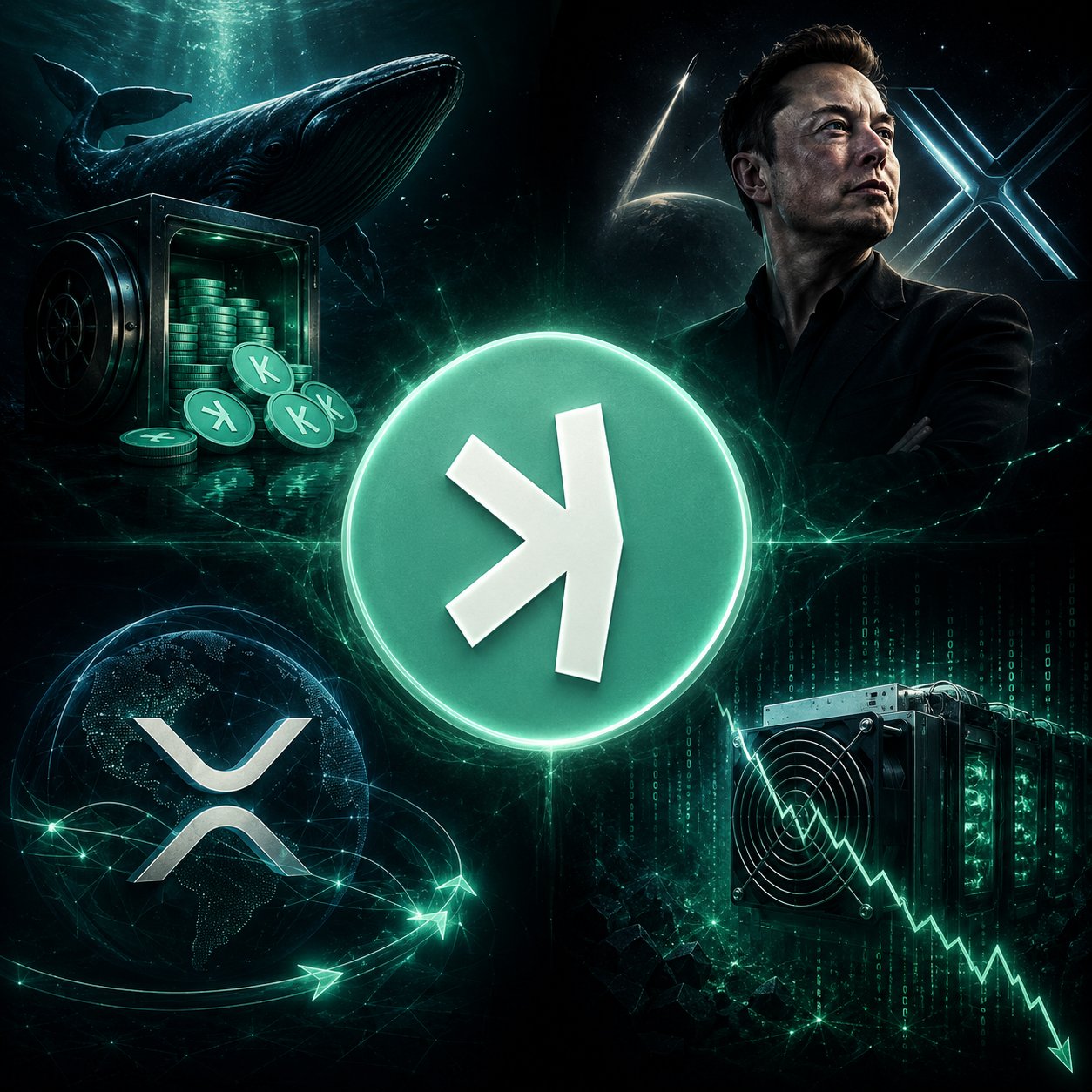
KASPA: The Billion-Dollar Whale, Elon Musk, XRP, and the Uncomfortable Truth About the Hashrate While many investors focus solely on Kaspa's declining price, something noteworthy is happening on the blockchain: the address known as “Entity X” continues to accumulate. The address now holds roughly 1.47 billion KAS, controlling about 5.35 % of the current circulating supply. At today’s price this is worth about $41 million. Within a single day the balance grew by roughly $190,000, equivalent to about 6.8 million KAS. Entity X is therefore the largest known address that analysis platforms do not directly link to an exchange. That undoubtedly looks like massive conviction. Still, we should clearly distinguish what the blockchain shows and what the community infers from it. We see KAS flowing to this address, but we do not know who the economic owner is. It could be a single large investor, or a fund, a market maker, an OTC desk, a custodian, or an address aggregating multiple clients’ balances. Even outflows from known exchange addresses do not automatically prove that all coins were bought directly on the market. Entity X is a strong on-chain signal, but not proof of an imminent rally. Why Kaspa Still Stands Out Technically Kaspa launched in November 2021 as an openly accessible Proof‑Of‑Work network without premine, pre‑sale, or reserved insider allocation. All circulating coins were created through mining. This is a key differentiator in an industry where teams and early investors often secure large portions of the supply. The decisive technical difference from classic blockchains lies in the BlockDAG. In Bitcoin, simultaneously found blocks compete and only one becomes part of the main chain. Kaspa can let parallel blocks exist and later order them into a common sequence via GHOSTDAG. The network currently runs at ten blocks per second, without replacing Proof‑Of‑Work with Proof‑Of‑Stake. This is the core Kaspa thesis: Proof of Work itself is not inherently slow; the linear architecture of traditional blockchains limits its speed. Thus, Kaspa tries to combine Bitcoin-like properties—UTXO structure, open participation, self‑custody, Proof of Work, and a fixed money supply—with very short confirmation times and substantially higher throughput. This does not automatically make Kaspa “perfect money”. However, it does make Kaspa one of the most interesting attempts to make digital Proof‑Of‑Work money scalable for everyday payments and applications. Did Elon Musk already describe Kaspa in 2021? On May 15 2021, Elon Musk wrote that Dogecoin should increase its block speed and block size each by a factor of ten and reduce its fees by a factor of one hundred. When asked why he didn’t simply develop a new cryptocurrency, Musk replied that it would only be necessary if Dogecoin could not meet those goals, as creating a new cryptocurrency is a major undertaking. Kaspa launched on November 7 2021, roughly six months after that statement. The similarity between Musk’s demand and Kaspa’s current design is striking: faster blocks, high throughput, and very low fees. But no serious conclusions can be drawn from that. There is no public evidence that Musk was thinking about Kaspa in his statements, that he was in contact with developers, or that he is now closely following KAS. The claim that Elon Musk will become the biggest KAS KOL is therefore a possible community narrative, not verified information. If Musk were to publicly discover Kaspa someday, his former demand would naturally be a perfect hook. Until then, the story should be presented as an interesting parallel, not a hidden connection. Kaspa vs. XRP: Who Wins in Cross‑Border Payments? In a pure technical capacity comparison, Kaspa has a strong starting position. During a Mainnet stress test the network reached a peak of 5,584 transactions per second. Over roughly 2,100 seconds, 4.62 million transactions were processed, averaging about 2,200 TPS. The XRP Ledger claims a sustainably reachable capacity of around 1,500 TPS on commercial hardware. However the numbers are not directly comparable: Kaspa’s figures are short‑term peaks and test averages, while XRP’s are an official benchmark for sustainable throughput. Even more important: an international payment infrastructure is not just about TPS. It also requires: - sufficient liquidity between different currencies, - regulated deposit and withdrawal pathways, - banks and payment service providers, - compliance and settlement systems, - reliable price formation, - institutional custody, and - legal certainty in the involved jurisdictions. Here Ripple currently has a clear lead. Ripple already operates a global payment infrastructure for banks, fintech firms and other business customers. Today, alongside XRP, the XRP Ledger and the stablecoin RLUSD also play important roles in these solutions. Kaspa, on the other hand, brings a different foundation: an open fair launch, Proof of Work, no central token allocation, and a BlockDAG architecture that enables high speed directly at the base layer. Thus the fair comparison reads: Kaspa offers the more interesting open Proof‑Of‑Work experiment. XRP and Ripple currently have the far more developed payment infrastructure, liquidity, and institutional connectivity. Kaspa does not currently “crush” XRP in real cross‑border payment traffic. It still lacks merchants, payment providers, fiat interfaces, liquidity corridors and actual transaction volume. Kaspa could become a serious long‑term competitor, but only once technical capacity translates into a real payment economy. KasMap: Community is important, but mass adoption is not yet there KasMap already provides a platform where Kaspians, merchants, groups, events, organizations, universities and job listings can be found. It aims to make visible where Kaspa is used, developed and accepted. This is a sensible building block, because a decentralized money system needs not only developers and investors, but also people, companies and places where it is actually used. However, KasMap is still primarily a directory and community platform. The number of entries should not be automatically equated with real payment volume. What matters is how many listed merchants regularly accept KAS and how many people actually use those offerings. @KasMaporg Interested parties can find the platform at: https://t.co/zOYnyTNmU4 The Kaspa hash rate drop is real The most critical part of the current Kaspa development is not the price, but the mining hash rate. Kaspa reached a peak of roughly 1.59 EH/s in early 2025. Current trackers show about 309 to 313 PH/s. That represents a drop of roughly 80 % from the historic high. Values may vary slightly depending on measurement timing and methodology, but the overall downward trend is clear. That does not mean Kaspa is on the brink of a death spiral. Kaspa has a sliding difficulty adjustment that adapts mining difficulty to the available hash power, stabilizing the target block rate. If miners leave, the remaining miners can continue producing blocks after the adjustment. The difficulty adjustment, however, only solves the technical problem of block production. It does not replace the lost economic security. If the hash rate drops significantly, the computational power an attacker would need to surpass is reduced. How realistic an attack would be also depends on the amount of suitable ASIC hardware available, the concentration of mining pools, and whether external hash power can be mobilized quickly. Therefore it would be wrong to dismiss the drop as meaningless. It is not an automatic death sentence, but a serious security and economic indicator. The rapid emission schedule plays a decisive role. In Kaspa, the block subsidy halves once per year. Unlike Bitcoin’s single halving event, it occurs via monthly reductions by the factor (1/2)^(1/12). This makes the halving period four times faster than Bitcoin’s. At the same time, Kaspa is now mined almost exclusively with specialized ASICs. The claim that Kaspa is currently a GPU‑mined network is outdated. GPUs were relevant in the early phase but have largely been replaced since mid‑2023 by much more efficient kHeavyHash ASICs. For a miner, the main factors are: - the KAS price, - the block subsidy, - transaction fees, - hardware efficiency, - electricity and operating costs. When the KAS price and block subsidy fall simultaneously, revenues in dollars or euros collapse. Older, less efficient devices become unprofitable and are shut down. New ASIC generations can also displace older machines even if overall network activity remains unchanged. Thus the emission plan is an important reason for the decline, but not the only one. Price development, electricity costs, ASIC efficiency, manufacturer policies, and miner distribution also play roles. With the Toccata hard fork, Kaspa received native Covenant programming and foundations for ZK‑based applications on June 30 2026. At the same time, the minimum fee for standard forwarded transactions was raised from 1 to 100 Sompi per gram, a hundred‑fold increase of the previous fee floor. A technical detail is important: this minimum fee is a node and mempool rule, not a consensus rule. A fee‑free transaction remains valid from a consensus perspective, but normal nodes will not readily forward or accept it into the mempool. The fee increase fundamentally improves revenue per transaction, but it does not yet create a sustainable fee market. Even a hundred‑fold increase yields little without sufficient transaction volume. For fees to become a significant long‑term share of mining revenue, Kaspa needs real applications with continuous demand: payments, trading, native assets, wallet services, secure vaults, ZK applications, and other Covenant‑based products. Toccata provides new tools for this. Whether killer apps and lasting fee revenue emerge remains to be seen. A possible tail emission is repeatedly discussed in the community. However, it is not a decided change to Kaspa’s monetary policy and should not be presented as already part of the protocol. Kaspa is also not error‑free. Kaspa experienced a network error shortly after Mainnet launch, causing a two‑to‑three‑day outage in November 2021 and prompting the first hard fork. In December 2023, there was another brief pause in block acceptance. The incidents were documented and addressed, showing that even a strong research project is not infallible. This does not fundamentally oppose Kaspa. It only argues against the claim that any relatively young protocol is already “perfect”. My summary The strongest Kaspa narrative isn’t Elon Musk or an unknown billion‑dollar wallet. The decisive question is: Can a fairly launched, decentralized Proof‑of‑Work BlockDAG generate enough real usage, liquidity and fees before the block subsidy continues to shrink? Entity X provides an interesting bullish signal, but no guarantee. The hash‑rate decline is a warning, but not yet a death spiral. Toccata creates new technological possibilities, but does not automatically bring users. Kaspa has an extraordinary technical foundation. Whether it becomes a global digital money is decided not solely by the maximum TPS figure, but by real adoption. Perfect money? Not yet proven. One of the most ambitious Proof‑of‑Work experiments of our time? Definitely.
 11 0 260 أصلي >اتجاه KAS بعد الإصدارمحايدArticle analyzes KASPA's technical potential and challenges such as declining hash rate and lack of applications, maintaining an objective neutral stance.
- Classic Founder Researcher B3.35K @Classicxbt
 Gabriel 𐤊 D687 @GabrielNico21
Hello Kaspa / Kaspa memes army ! Should KRC20 migrate to KCC20 ? @kasplex
13 1 811 أصلي >اتجاه KAS بعد الإصدارمحايدKAS community discusses whether KRC20 should migrate to KCC20, with no clear inclination yet. - Classic Founder Researcher B3.35K @Classicxbt
Robinhood Chain is a distraction. Real alpha is coming with DeFi on Kaspa.
27 2 663 أصلي >اتجاه KAS بعد الإصدارصاعدKaspa DeFi is about to launch, expected to rise - Classic Founder Researcher B3.35K @Classicxbt
 Sukie D49.34K @bySukie
Bought more $KAS today, couldn’t resist not bidding this chart Kaspa’s biggest KOL is going to be @ElonMusk Kaspa launched 4 months after Elon said this & it went on a parabolic run, this is the longest accumulation phase $KAS has ever gone thru, healthy. https://t.co/ahIcC5Xnln
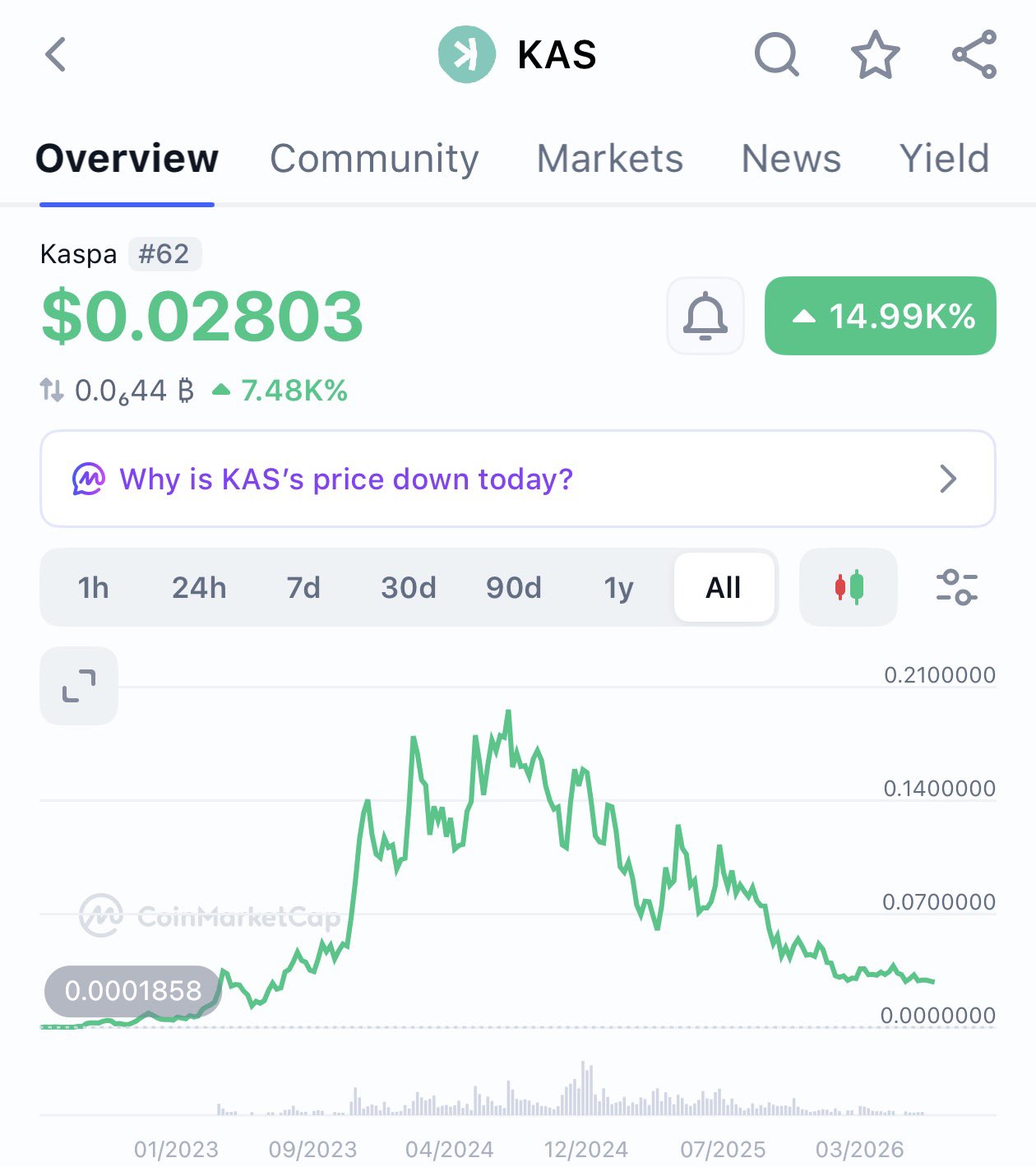
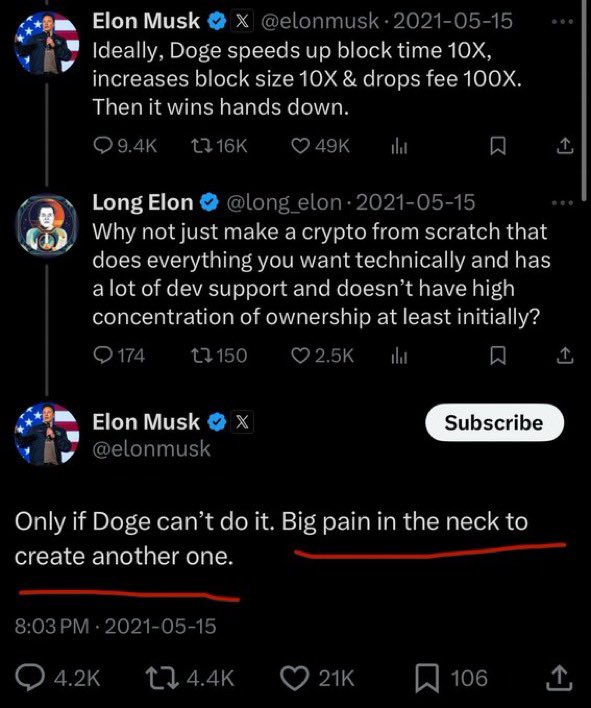 183 32 4.75K أصلي >اتجاه KAS بعد الإصدارمتصاعد بقوةThe author increased their position in KAS, believes it is in a healthy accumulation phase, and predicts Elon Musk will become its biggest KOL.


