Today I'm replying to Wei Shen's topic, and also mentioning other solutions that many folks in the comment section brought up at the time.
1. Synthetic assets – many veterans said that if all you want is a price exposure similar to a spot stock, want to hold it long‑term, and avoid the funding‑rate erosion of Perps, synthetic assets are the best way.
I have personally followed this from the SNX era, through Luna's Mirror, and even consider GMX's GLP as a “variant synthetic asset”. Many of its designs are very fancy. I vaguely recall the awe I felt during the DeFi Summer when I first saw SNX synthetic assets and the GLP design (GLP has no stocks; later GNS, inspired by GLP, created a synthetic asset pool that can trade everything, including stocks).
However, the market has already voted with real money, and users ultimately chose real assets (or what could be called trustworthy mapped assets) > synthetic assets.
It has nothing to do with decentralization, technology, or mechanisms; it is simply a more trustworthy asset backed by real assets.
Interestingly, the synthetic assets that survived without ever reaching the top—one DAI (USDS) and one USDE—are both semi‑centralized solutions.
2. Tokenized stocks – Over a year ago I was fortunate to discuss a topic with “Big Sister”. She asked me what I think is the biggest problem in the crypto space. I answered, “We have over‑financialized too many things,” viewing memes, GameFi, AI Crypto from a VC perspective as trying to hit a nail with a hammer.
She replied that she believes we lack good assets. Essentially we were saying the same thing. I then asked if Binance had ever considered launching stock trading; she said Binance tried in 2021, but regulatory pressure was too high and the product was taken down after a few months.
Thus, tokenized stocks are actually a second attempt in our community. The first trials by Binance and FTX in ’21 were halted by regulators — but now established CEXs like Binance, Bitget, and platforms such as BIT, StableStock, and MSX are revisiting it, indicating that regulatory environments and product structures have evolved and it’s not a simple repeat.
3. Soul‑blood in the hands of longstanding foes – Here I agree with Wei Shen’s view that “the equity behind stocks is fundamentally a product of a single government’s power” and that “those whose interests are harmed are themselves the rule‑makers.” However, we can look at it from another angle – if you consider Alpaca as Tether, does the logic then hold throughout?
Stablecoins are currently one of the most widely used and successful products in crypto. No one would say that because the dollar is controlled by the Federal Reserve, stablecoins have an inherent flaw.
In other words, “centralized underlying assets” ≠ “tokenization has no value.”
Of course, Alpaca does not yet have Tether’s scale or reputation, but when USDT first started, Tether also faced various doubts—about asset reserves, fears of Fed intervention, or usage for regulatory arbitrage, gray‑market activities, even terror financing… Yet after a few years it has grown to a several‑hundred‑billion‑dollar size.
Stablecoins are now seen as one of the tools for the global expansion of US dollar dominance; why can’t tokenized stocks be seen similarly as a means for the global expansion of dollar‑denominated assets?
If we say “those whose interests are harmed are the rule‑makers, and if the impact becomes large enough it will be vetoed” — then saying that in the coming years the impact will be large enough to be vetoed actually proves a point: that the scale of impact itself demonstrates its value and vitality, which is strikingly similar to the growth path of stablecoins. How the ultimate regulatory framework evolves is another matter.
In the past decade‑plus, Crypto has continuously created new trading methods but rarely created new high‑quality assets. When a market lacks asset supply, it keeps financializing existing assets. Memes, Perps, and various high‑leverage products are essentially the result of this.
From this perspective, tokenized stocks may not be about creating new financial instruments but about providing Crypto with new asset supply. Some arbitrage is just a current feature, not the whole goal. On one side, major CEXs and users genuinely crave high‑quality assets; on the other, in the de‑globalization macro backdrop, the global expansion of the dollar and dollar‑denominated assets aligns supply and demand perfectly. Therefore, I am firmly bullish on the future of tokenized stocks :)

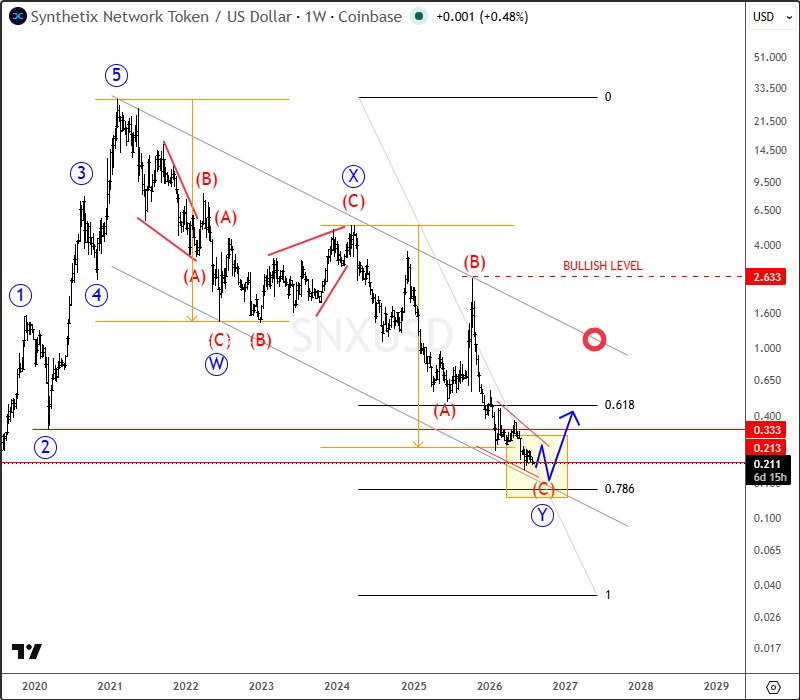
Synthetix (SNX)
Synthetix Live Kursdaten
Synthetix SNX Preisverlauf USD
Besitzen Sie SNX jetzt
Kaufen und verkaufen Sie SNX einfach und sicher auf BitMart.Verdienen
Setzen Sie Ihre ungenutzten Kryptowährungen ein und erzielen Sie passives Einkommen durch Ersparnisse, Staking und mehr.Synthetix X Insight
I tend to agree with the poster because, from first principles, the ‘shares of a listed company’ correspond to ‘equity of the listed company’, which is entirely subject to a single government’s centralized authority.
If shares are turned into tokens for some arbitrage (your point 4), the harmed parties are themselves the rule‑makers; either the arbitrage impact isn’t large enough, or if it is, it gets a centralized veto. Points 1‑3 are also not decisive factors.
It’s like in a cultivation world where the soul‑blood is held by a longstanding foe.
This fundamentally differs from the broader monetary value behind Crypto. Crypto can persist because its nodes are not all in one country; even the currently speculative DeAI satisfies this. But the equity behind stocks is inherently a product of a single government’s power. This hard flaw means there isn’t sufficient justification for tokenization.
No shit. The fundamentally unsound stablecoin didn’t work.
$SNX is still way overvalued any if you hold any, liquidate and allocate into something that has a chance, like $AAVE, $FLUID, $EUL or simply $ETH.
New Synthetix Improvement Proposal:
SIP-423 has been proposed to retire legacy sUSD and reform 420 Pool Staking
Summary:
SIP-423 proposes retiring legacy sUSD, restructuring the Debt Jubilee, and reforming SNX staking to establish a sustainable long-term foundation for Synthetix.
SIP-423 achieves two primary outcomes:
🔹Sunsetting of sUSD on Ethereum mainnet and Optimism. sUSD will be wound down and converted to newly minted SNX on Ethereum Mainnet
🔹Restructuring of the 420 Pool Debt Jubilee and SNX staking
Please visit the official Synthetix SIPs site at the link below to view all details concerning SIP-423, including the voting timeline and all planned changes:
🔗 https://t.co/RViOObwlDq
For all discussions & queries relating to SIP-423, please head to the official Synthetix Discord: https://t.co/9T9HPnXlWf
Havent seen a platform thus mispriced since snx in 2020
Preisprognose
Wann ist ein guter Zeitpunkt, um SNX zu kaufen? Soll ich SNX jetzt kaufen oder verkaufen?
Beacon Vorhersage
Probabilistische Preisprognose (nächste 24 Stunden)Diese Prognose ist ein experimentelles technisches Produkt und wird lediglich zu Informationszwecken angegeben. Dies stellt keine Anlageberatung dar. Unerwartete Ereignisse in der realen Welt können erhebliche Auswirkungen auf das Marktverhalten haben. Händler sollten Entscheidungen mit Vorsicht treffen.
Mehr entdecken
BM Discovery
Neuer Eintrag