Rewards
Futures Daily Draw
100% Chance To Win With Daily Trades
Spot Daily Draw
Win 8,888 USDT In Grand Prizes
Mobile Top-Up
Top up mobiles easily, online, secure
Send
Send money globally, fast and secure
BitMart Mall
Live on crypto

PUMP PUMP Price History USD
Track the price of PUMP for today, 7 days, 30 days and 90 days
Period
Change
Change (%)
Today
$ 0.0000099
-10.00%
7days
--
--
30days
--
--
90days
--
--
Own PUMP Now
Buy and sell PUMP easily and securely on BitMart.
PUMP Market Information
$ 0.000089 24h Range $ 0.000099
All time high
$ 0
All time low
$ 0
24h Change
-10.00%
24h Vol
$ 46.69
Circulating supply
465.79B
PUMP
Market cap
$ 41.90M
Max supply
1.00T
PUMP
Fully diluted market cap
$ 89.96M
Trade PUMP

PUMP X Insight

Keith Berry
NFT_Expert
Influencer
C
 221.3K @kokid951
 Extremely Bullish
The project announced the burning of 200 million PUMP tokens and plans to increase ecosystem value through multi-faceted development.

OMEN D
39.0K @omenatiii We are happy to announce that https://t.co/RVT2Stb78J
has so far brought in total of 200 000 000 solana:GZyqN8VmXrfoyyYRob5Lu2xGiXTcg1aLaNmptUpKpump tokens ready to be burned and removed from circulation.
- Gaming
- Art upgrades
- IP expansion
- Token Holders rewards
- Staking
And much more coming in the upcoming days.
We are dedicated and committed in adding more value to the now multichain ecosystem we built over the past few years.
More updates and announcements to follow

 58
58
 11
11
 1.4K
1.4K
2026-09-05 01:36
Trend of PUMP after release
Extremely Bullish
The project announced the burning of 200 million PUMP tokens and plans to increase ecosystem value through multi-faceted development.

King Wabi (Mr Big Business)
Influencer
Trader
C
20.0K @KingWabi Extremely Bullish
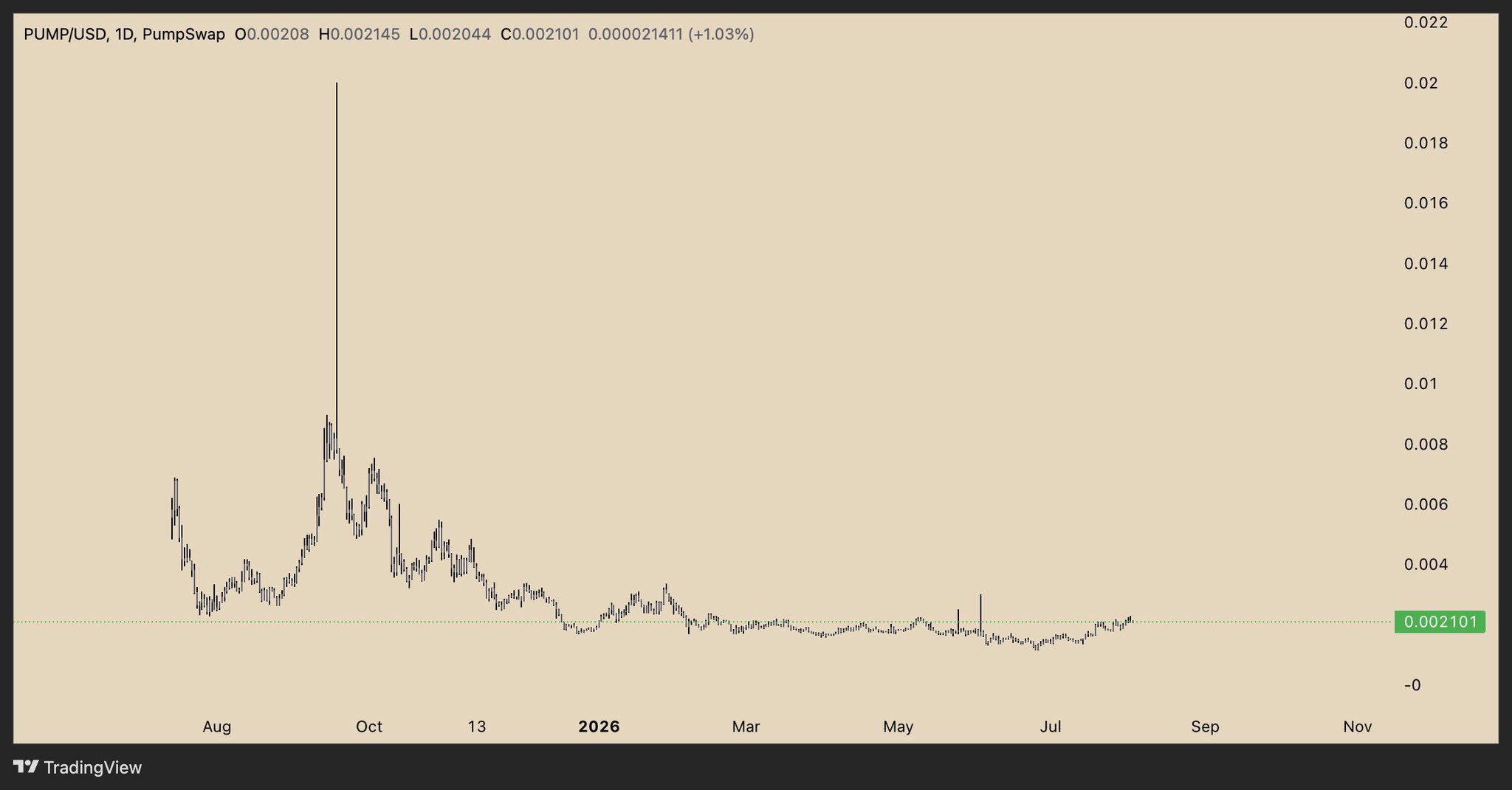
The author is extremely bullish on PUMP, believing it has been accumulating for 6 months and is poised for a massive BNB-level rally.
If you ever think that we ever see an onchain season again like we did in 2024, then you best believe that $PUMP will catch one of the biggest buy side bids we have ever seen since $HYPE in late 2024.
Anytime PUMP catches a bid, there's something always popping in the trenches. You don't see nearly 6 months of accumulation while majors still grind down without some sort of massive upside resolution once majors stop nuking.
IMO this will catch a BNB type of bid should @Pumpfun remain good as a business. I also believe if you are remotely bullish on Solana, this should be a no brainer for beta.
 1
1
490
1
1
490
2026-08-03 15:37
Trend of PUMP after release
Extremely Bullish
The author is extremely bullish on PUMP, believing it has been accumulating for 6 months and is poised for a massive BNB-level rally.

Hyoga
TA_Analyst
Trader
C
27.5K @lunanomacrypto Bullish
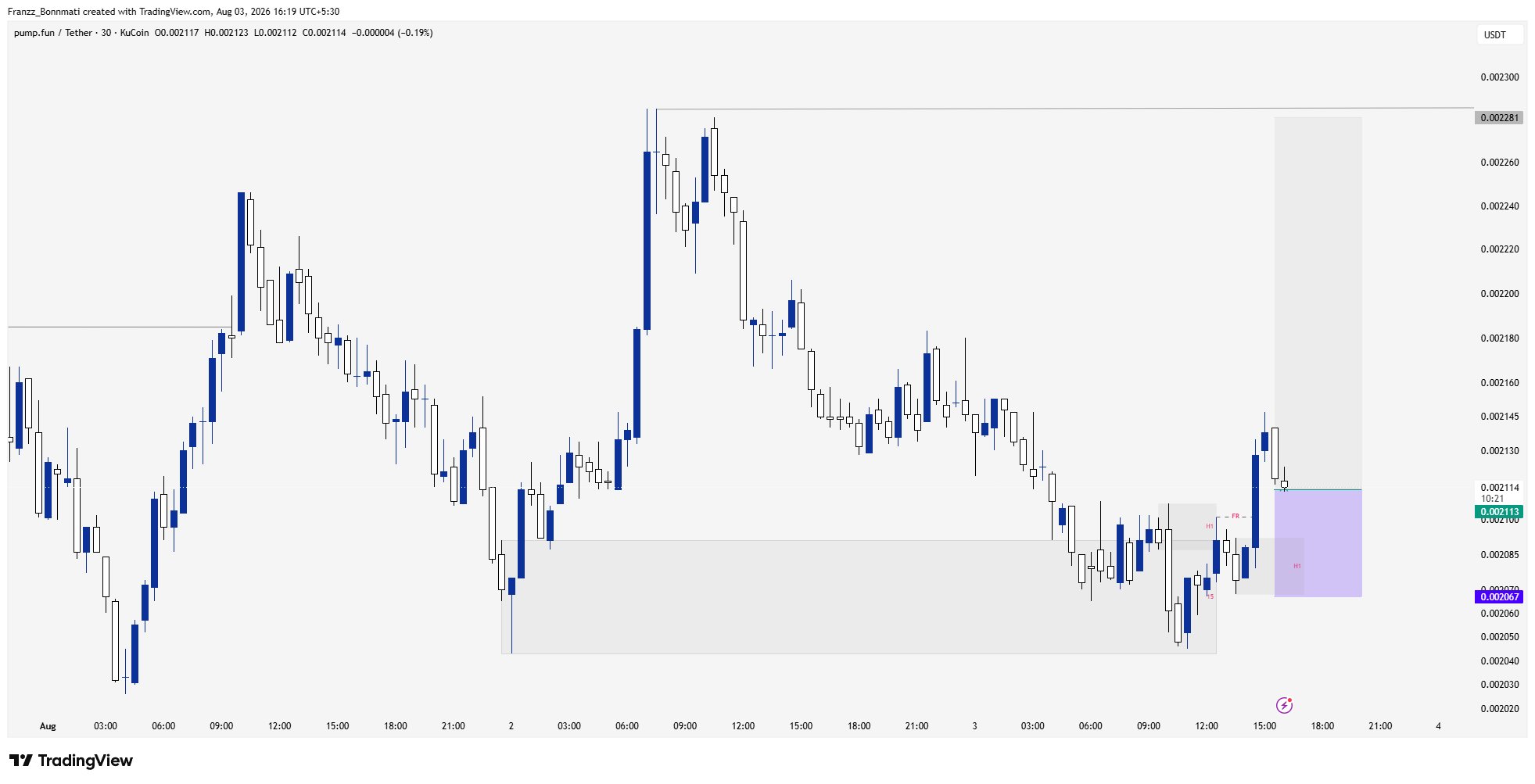
PUMP long strategy, entry 0.002113, take-profit 0.002281.
$PUMP
E: 0.002113
SL: 0.002067
TP: 0.002281
RR: 3.65 https://t.co/zGVeVBWHoR
Hyoga
TA_Analyst
Trader
C
27.5K @lunanomacrypto Closing it at BE.
3
0
361
2026-08-03 10:57
Trend of PUMP after release
Bullish
PUMP long strategy, entry 0.002113, take-profit 0.002281.
Price Prediction
When is a good time to buy PUMP? Should I buy or sell PUMP now?
When deciding whether it’s a good time to buy or sell PUMP (PUMP), it’s important to first align with your own trading strategy and risk profile.Long-term investors and short-term traders often interpret market conditions differently, so your decision should reflect your personal approach. According to the latest PUMP 4-hour technical analysis, the current trading signal is Buy.

Beacon Prediction
Probabilistic Price Forecast (Next 24 Hours)Beacon Prediction Disclaimer
The data results displayed on this page are analyzed based on actual trading data (OHLCV) of the selected trading pair along with corresponding technical indicators.
This prediction is an experimental technical product and is provided for reference purposes only. It does not constitute investment advice. Unexpected real-world events may significantly impact market behavior. Traders should make decisions with caution.
This prediction is an experimental technical product and is provided for reference purposes only. It does not constitute investment advice. Unexpected real-world events may significantly impact market behavior. Traders should make decisions with caution.
About PUMP
PUMP (PUMP) is a cryptocurrency launched in 2024and operates on the Solana platform. PUMP has a current supply of 999,999,991 with 0 in circulation. The last known price of PUMP is 0.00009509 USD and is down -0.01 over the last 24 hours. It is currently trading on 3 active market(s) with $29.20 traded over the last 24 hours. More information can be found at https://pumpsolana.xyz/.
Read More
Buy PUMP
Trade PUMP