Bitmine Immersion Technologies said it increased its Ethereum treasury last week, bringing its Ether holdings to nearly 6 million ETH and positioning a large portion of that stack to earn staking yield. The company also pegged potential annualized staking revenue in the hundreds of millions of dollars, a framing that underscores how some crypto-focused public companies are moving from “hold-and-hope” balance sheets toward cash-flow-like strategies.
In a Monday announcement, Bitmine disclosed that it purchased 27,180 ETH during the prior week. The acquisition lifts its Ether holdings to more than 5.95 million ETH, valued at roughly $15.4 billion—about 4.9% of Ether’s circulating supply. When cash and other crypto assets are included, Bitmine reported total holdings of approximately $15.8 billion.
Key takeaways
- Bitmine added 27,180 ETH last week, taking its total to over 5.95 million ETH (roughly $15.4 billion).
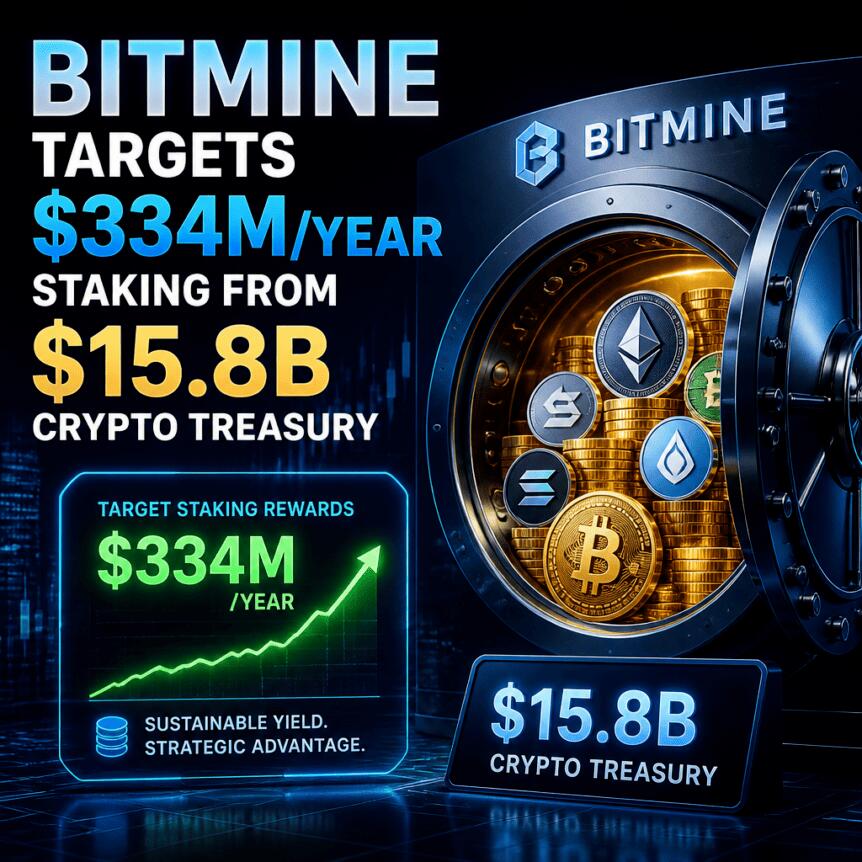
- More than 5.06 million ETH is now staked, with Bitmine estimating $334 million in annualized staking revenue at current rates.
- With about 85% of its Ether staked, Bitmine is betting heavily on recurring yield rather than purely capital appreciation.
- Compared with Bitcoin treasury strategies, staking-native assets can introduce different performance drivers—especially in volatile markets.
Bitmine turns a large Ether treasury into staking yield
Bitmine’s update emphasizes the income component of its Ethereum strategy. According to the company, more than 5.06 million ETH is currently staked. At the rates Bitmine cited, that corresponds to an estimated $334 million in annualized staking revenue.
The staking ratio matters to the thesis the company is building. Bitmine said roughly 85% of its ETH is staked, meaning a majority of the treasury is earning network rewards rather than sitting idle. That approach aims to smooth returns across market cycles: even when price volatility hits the value of holdings, staking yield can still continue to accrue.
Bitmine also drew a direct comparison to Grayscale’s Ether staking product. According to the fund’s webpage for the Grayscale Ethereum Staking ETF (ETHE), the product holds 84.6% of its Ether staked. While Bitmine is not an ETF, the parallel suggests investors are familiar with—and can benchmark—how much staking allocation is considered “typical” for yield-focused Ether exposure.
That yield-bearing design is a notable difference from many Bitcoin treasury models. Bitmine’s framing highlighted that Bitcoin holdings do not generate native staking yield in the same way Ethereum staking does. For investors tracking these companies, the implication is that performance can diverge based on what the balance sheet earns mechanically, not only how the market reprices the underlying asset.
What the numbers imply for treasury economics
Bitmine’s reported Ether count—5.95 million ETH and rising—puts the company among the largest corporate holders by staking-enabled exposure. At the figures provided, the company’s Ether holdings alone are valued around $15.4 billion, with additional crypto and cash pushing total holdings to approximately $15.8 billion.
The key takeaway for investors is that Bitmine’s narrative is not only about the size of its treasury; it’s about the percentage of that treasury that is deployed into an activity that generates ongoing rewards. When a company can claim that a substantial share of its holdings is staked, it can more credibly argue for recurring value creation, rather than relying on market appreciation to outperform.
Still, readers should note what is not spelled out in Bitmine’s announcement. The estimated annualized staking revenue is explicitly tied to “current rates,” meaning the figure can move if network participation, reward dynamics, or market pricing changes. The company’s economics, therefore, remain exposed to both Ethereum’s staking environment and broader crypto market conditions.
Stock performance and how the market is pricing the strategy
On the day of the announcement, Bitmine shares were little changed, trading just below $25 during morning trading. Yahoo Finance data cited in the report indicates the stock has gained nearly 38% over the past month, but is still down year to date.
That split—strong short-term momentum but a weaker longer-term trend—suggests investors may be evaluating Bitmine’s treasury expansion and staking yield thesis in stages, rather than committing fully immediately. For traders and long-term holders alike, this is often what happens when a company begins translating a balance sheet strategy into more concrete income expectations: the market reacts, but repricing can be uneven as investors test whether the assumptions hold over time.
Bitmine’s strategy direction is also consistent with earlier coverage noted in the source material, including reporting that the company had been working toward a broader treasury accumulation target.
Strategy (MicroStrategy) continues reallocating toward preferred stock
While Bitmine leaned further into Ethereum staking, Michael Saylor’s Strategy signaled a different capital allocation pattern. The company, according to a Monday filing and related reporting in the source, went a second consecutive week without buying Bitcoin.
Instead, Strategy repurchased shares of its STRC preferred stock. It said it repurchased about 1.42 million shares for $139.3 million between Sept. 8 and Sept. 13. The filing also referenced earlier activity: Strategy bought back $176.3 million worth of STRC the previous week.
Strategy’s Bitcoin balance, meanwhile, was reported as unchanged at 845,050 BTC as of Sept. 13. Its last disclosed Bitcoin purchase came in late August, when the company acquired 4,603 BTC for $369.7 million—an event described in the source as its first Bitcoin purchase since June.
The contrast between Strategy’s paused Bitcoin buying and Bitmine’s continued accumulation of staked Ethereum highlights a broader tension in corporate crypto investing: whether returns are expected primarily from additional spot accumulation, from balance-sheet restructuring, or from yield-like mechanisms attached to the asset. In Strategy’s case, the recent behavior points to a focus on supporting its preferred stock program alongside its existing BTC exposure; Bitmine, by contrast, is emphasizing that Ether itself can supply recurring staking rewards once held.
What remains to watch is whether these two approaches converge in investor expectations. If staking yield stays attractive and Bitmine sustains high staking utilization, its treasury could increasingly be judged on cash-flow-like characteristics. If, however, staking economics or network reward conditions shift, the company’s annualized estimates could be revised and the market may reprice the strategy accordingly.
This article was originally published as Bitmine Targets $334M/Year Staking From $15.8B Crypto Treasury on Crypto Breaking News – your trusted source for crypto news, Bitcoin news, and blockchain updates.
Disclaimer: The market is risky, and investment needs to be cautious. This article does not constitute investment advice. Users should consider whether any opinions, views, or conclusions in this article are in line with their specific circumstances. Investment based on this is at their own risk.