Get Started
Scan to Download App
iOS & Android
BitMart / Crypto / NEWT

Newton Protocol (NEWT)

$
$ 0.050 (NEWT/USD)
-2.69%
24H

Newton Protocol Live Price data

Today's price of Newton Protocol Is $ 0.050 (NEWT/USD). With A Market Cap Of $ 14.61M USD. 24-Hour Trading Volume Of $ 623.56K USD, A 24-Hour Price Change Of -2.69%, And A Circulating Supply Of 288.46M NEWT.

Newton Protocol NEWT Price History USD

Track the price of Newton Protocol for today, 7 days, 30 days and 90 days
Period
Change
Change (%)
Today
$ 0.0013
-2.69%
7days
$ 0.0015
3.22%
30days
$ 0.0014
-2.73%
90days
$ 0.013
-20.90%

Own NEWT Now

Buy and sell NEWT easily and securely on BitMart.
Buy/Sell NEWT Now
Buy/Sell {0} Now
Newton Protocol Market Information
Last price $ 0.050
$ 0.048 24h Range $ 0.052
All time high
‎$ 0.85‎
All time low
‎$ 0.024‎
24h Change
‎-2.69%‎
24h Vol
‎$ 623,559.10‎
Circulating supply
1.00B NEWT
Market cap
‎$ 50.65M‎
Max supply
1.00B NEWT
Fully diluted market cap
‎$ 50.65M‎
Trade NEWT

Earn

Put your idle crypto to work and earn passive income through savings, staking, and more.
Try Now
Try Now

Newton Protocol X Insight

avatar
Newton Protocol's Verifier economic model ensures network security and long-term operation through incentive and penalty mechanisms.

What really deserves discussion here is not how an attestation is signed, but why a verifier is willing to sign honestly all the time.

This afternoon I went through @newton_xyz's design document about verifiers and found that it does not rely on “node self-discipline” for security, but instead uses an economic model that makes honesty the most profitable choice.

Currently $NEWT is at $14.57, with a 24‑hour pullback of 3.25%. In a weak market like this, it becomes easier to see whether an incentive mechanism has resilience. If a slight price drop removes the nodes' motivation to maintain the network, it indicates a problem with the model itself.

Newton's incentive mechanism can be roughly divided into four layers.

The first layer is the most direct reward. For each successful attestation, a verifier receives the corresponding gas reward. The more they participate and the more verifications they complete, the higher their income; workload and reward are essentially positively correlated.

The second layer is a penalty mechanism. If a verifier signs incorrectly, misses a signature, or colludes with a strategy party to cheat, the staked tokens are slashed. In many cases, the loss from a single violation far exceeds the verification rewards that can be earned in a short period. For a node, misbehavior is a transaction with a very low risk‑return ratio.

The third layer is a random rotation mechanism. Verifiers are not permanently assigned to a specific batch of tasks; they are reassigned each block cycle. No one can know in advance which verifier will handle the next verification, meaning that sustained collusion would require control over a large number of nodes, and the attack cost rises with network size. This aligns with the approach of many PoS networks to reduce the risk of collusion.

The fourth layer gives the strategy party discretionary selection rights. Capital managers can customize a verifier whitelist based on stake size, historical performance, reputation score, KYC completion, and other criteria. Nodes that do not meet the requirements may even be denied verification eligibility, further shrinking the potential space for malicious behavior.

The entire network scale forms the real closed loop.

As the number of Vaults grows and strategy execution becomes more frequent, the demand for on‑chain rule verification also continuously increases. Consequently, the number of attestations rises, and verifier revenue becomes increasingly dependent on real business rather than purely on token incentives.

This point differs greatly from traditional oracles.

Oracles answer the question “What is the price?”.

Verifiers answer the question “Does this rule truly satisfy the condition?”.

The former provides data, while the latter is responsible for execution confirmation, bearing a clearly higher responsibility. Therefore, its staking requirements, penalty severity, and economic constraints are all stricter. When an oracle fails, the impact is mainly on reputation; when a verifier misbehaves, the loss is the staked principal.

If we combine this with the VaultKit introduced this morning, the two parts fit together to form a complete picture.

VaultKit writes strategies and rules onto the chain.

Verifier ensures that these rules are executed correctly and uses economic incentives to constrain the entire verification process.

One solves how rules are implemented; the other solves how rules are executed trustworthily.

After the mainnet Beta launch, this Verifier economic model becomes the fundamental foundation that truly supports the protocol's long‑term operation. No matter how complex or sophisticated the rule design, without sufficiently strong incentive and penalty mechanisms to constrain verifiers, it will remain merely a paper design.
#Newt #NewtonProtocol #DeFi #链上金融

view 16
view 14
view 489
2026-07-05 12:37
Trend of NEWT after release
Bullish
Newton Protocol's Verifier economic model ensures network security and long-term operation through incentive and penalty mechanisms.
avatar
Newton mainnet Beta launched, offering on-chain compliance authorization, and the author believes it is undervalued.

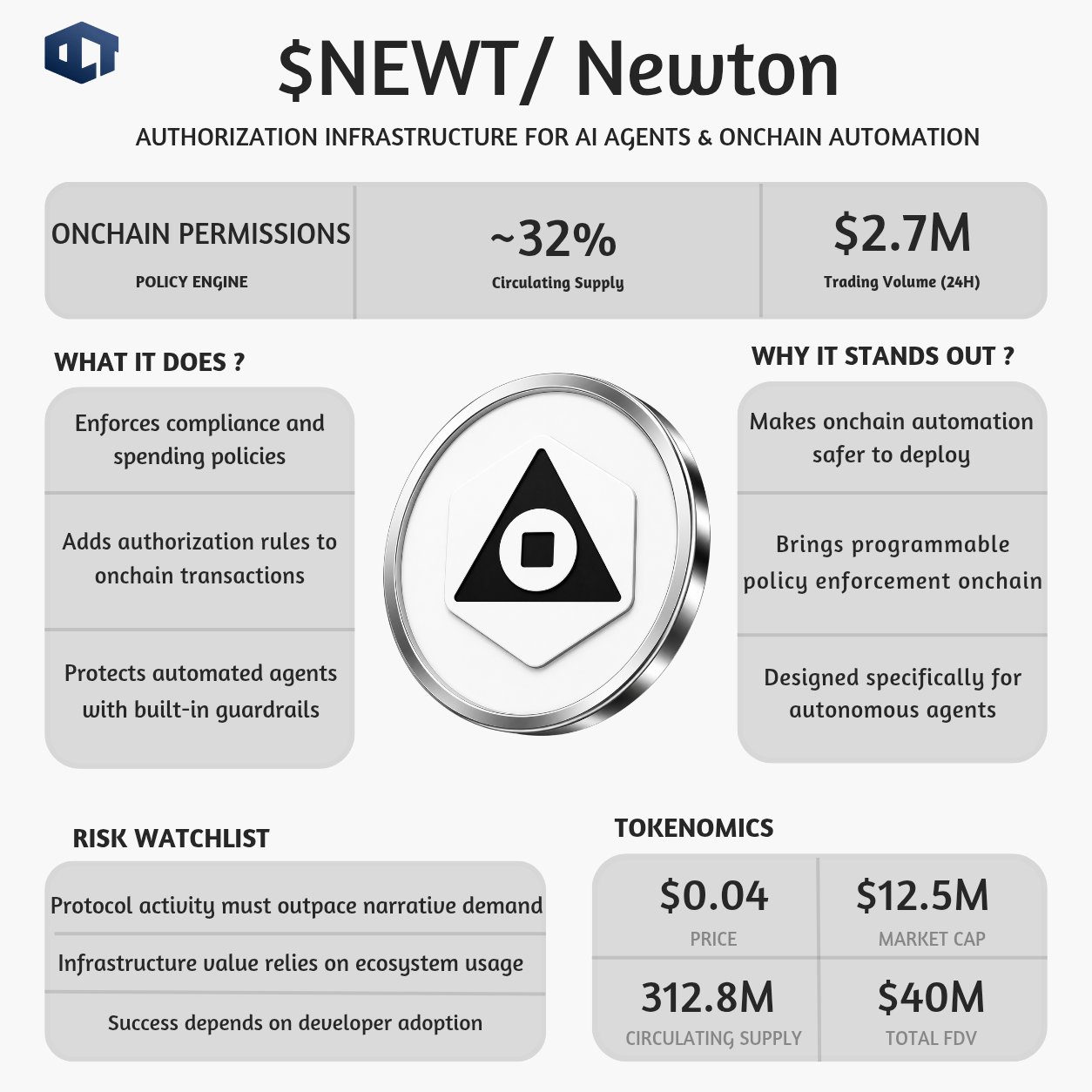
Newton just launched Mainnet Beta alongside VaultKit, bringing programmable compliance rules and policy enforcement directly onchain.

$NEWT still sits near a ~$12M market cap.

Why is the market barely valuing infrastructure designed to make AI agents and automated vaults safer to use?

Newton is building an authorization layer for onchain transactions and autonomous agents.

The protocol allows developers to define rules that must be satisfied before any transaction can execute.

Those rules can include:

• Identity requirements
• Jurisdiction restrictions
• Spending limits
• Custom compliance policies
• Agent guardrails

The goal is making automation safer.

As AI agents begin managing assets and executing transactions, protocols may need policy layers that prevent unauthorized or non-compliant actions.

That is where Newton positions itself.

Unlike general agent frameworks, Newton focuses specifically on transaction authorization and policy enforcement across chains.

There are still important challenges.

Infrastructure layers face a classic adoption problem.

The technology can function perfectly, but long-term success depends on:

• Developers integrating the protocol
• Institutions adopting policy engines
• Agents using the authorization layer in production

Without ecosystem adoption, infrastructure alone creates limited value.

Supply is another consideration:

• ~264M tokens currently circulate
• Maximum supply is capped at 1B
• Future value depends primarily on protocol activity rather than narrative alone

At the same time:

• No major exploit history surfaced
• No public governance controversies emerged
• Development remains focused on practical automation and compliance infrastructure

Tokenomics

• Price: ~$0.04
• Market cap: ~$12.6M
• Circulating supply: 264.4M
• Max supply: 1B

Always take whatever you read on the internet with a pinch of salt, do your own research, NFA.

view 9
view 0
view 1.4K
2026-06-27 19:12
Trend of NEWT after release
Bullish
Newton mainnet Beta launched, offering on-chain compliance authorization, and the author believes it is undervalued.
avatar
作者卖出空投获利超10万美元,避免NEWT等代币90%暴跌,强调及时止盈。

Some of the airdrops I sold last year:

Newton: $17000 → $1500 today
Eclipse: $13000 → $500 today
Mira: $12000 → $300 today

These are just the tip of the iceberg. My airdrop profits last year exceeded $100K. Imagine if I held without selling

All that money is now going into an apartment in Singapore this year or next

avatar

The token i sold to build this house was around $120k when i sold it. i used less than $80k to build it.

fast forward today if i held? it will be worth less than $3k.

i am definitely buying it back at $2k as an act of respect 😂 https://t.co/FKj5QpyyNx

view 154
view 49
view 19.9K
2026-06-26 03:37
Trend of NEWT after release
Bearish
作者卖出空投获利超10万美元,避免NEWT等代币90%暴跌,强调及时止盈。
Details

Price Prediction

When is a good time to buy NEWT? Should I buy or sell NEWT now?

When deciding whether it’s a good time to buy or sell Newton Protocol (NEWT), it’s important to first align with your own trading strategy and risk profile.Long-term investors and short-term traders often interpret market conditions differently, so your decision should reflect your personal approach. According to the latest NEWT 4-hour technical analysis, the current trading signal is Hold. According to the latest NEWT 1-day technical analysis, the current signal is Sell.
54
Hold
4-hour technical analysis of NEWT
Last Update 2026-07-06 19:59:59
40
Sell
1-day technical analysis of NEWT
Last Update 2026-07-07 00:00:00
beacon

Beacon Prediction

Probabilistic Price Forecast (Next 24 Hours)
i
Beacon Prediction Disclaimer
The data results displayed on this page are analyzed based on actual trading data (OHLCV) of the selected trading pair along with corresponding technical indicators.
This prediction is an experimental technical product and is provided for reference purposes only. It does not constitute investment advice. Unexpected real-world events may significantly impact market behavior. Traders should make decisions with caution.
About Newton Protocol
Newton Protocol (NEWT) is a cryptocurrency launched in 2025and operates on the Ethereum platform. Newton Protocol has a current supply of 1,000,000,000 with 288,458,130.03104902 in circulation. The last known price of Newton Protocol is 0.05099586 USD and is down -0.35 over the last 24 hours. It is currently trading on 157 active market(s) with $6,419,093.23 traded over the last 24 hours. More information can be found at https://newton.xyz.
Read More
Buy NEWT
Trade NEWT