Comprar cripto
tarjeta
Comercio P2P
Compra USDT en un marketplace
Tarjeta de crédito/débito
Compre criptomonedas con Visa o MasterCard
Pago vía prestadores
Compre criptomonedas a través de MoonPay, Simplex y más
Tarjeta BitMart
Impulsando su experiencia con las criptomonedas
Tarjeta prepago de criptomonedas
Obtenga una Mastercard lista para usar al instante
Comerciar
USDⓈ-M
Utilizando USDⓈ como colateral
COIN-M
Utilizando la propia moneda como colateral
TradFi
Trading integral para metales, acciones y forex
Operativa de demostración
Aprenda a operar con riesgo cero
Resumen de futuros
Plataforma única para todo lo relacionado con futuros
Rey de Futuros
Pool de premios de 478 000 USDT
Crecer
Resumen de Earn
Activos inactivos, gane con facilidad
Ahorros
Gane intereses conservando su portafolio.
Staking
Staking sencillo, cuantiosas retribuciones.
Gestión de patrimonio
Aumente su riqueza con un equipo de activos top
RWA
Mantenga BMRUSD, disfrute del rendimiento
Exclusivo VIP
Gane de forma estable para usuarios VIP
Rewards
Centro de recompensas
Descubra recompensas exclusivas por valor de hasta 14 000 USDT
LaunchPrime
Una plataforma para lanzar tokens y NFT
Programa de afiliados
Únase para ganar cuantiosas comisiones
Powerdrop
¡La solución AirDrop de próxima generación ya está AQUÍ!
Centro de eventos
El centro unificado para todas las operaciones de trading
Sorteo diario de futuros
100 % de probabilidades de ganar con operaciones diarias
Sorteo diario de Spot
Gane 8888 USDT en grandes premios
Recarga móvil
Recargue móviles de forma fácil, online y segura
Send
Send money globally, fast and secure
BitMart Mall
Viva de las criptomonedas

iExec RLC (RLC)
$ 0.73 (RLC/USD)
-3.90%
24H
iExec RLC Datos de precios en tiempo real
El precio de hoy de iExec RLC es de $ 0.73 (RLC/USD). Con una capitalización de mercado de $ 64.30M USD. Volumen de trading en 24 horas de $ 8.59M USD, Un cambio de precio en 24 horas de -3.90%. Y un suministro circulante de 87.00M RLC.
iExec RLC RLC Historial de precios USD
Siga el precio de iExec RLC para hoy, 7 días, 30 días y 90 días
Periodo
Cambiar
Cambio (%)
Hoy
$ 0.029
-3.90%
7días
$ 0.17
-18.75%
30días
$ 0.49
178.57%
90días
$ 0.49
178.57%
Sea propietario de RLC ahora
Compra y vende RLC fácil y seguro en BitMart.
iExec RLC Información de mercado
$ 0.72 Autonomía de 24 horas $ 0.77
Máximo histórico
$ 1.41
El mínimo histórico
$ 0.23
Cambio en 24 h
-3.90%
Volumen en 24 h
$ 8,591,630.25
Suministros en circulación
87.00M
RLC
Market Cap
$ 64.30M
Suministro máximo
87.00M
RLC
Capitalización de mercado totalmente diluida
$ 64.30M
Trade RLC
Ganar
Pon a trabajar tus criptomonedas inactivas y obtén ingresos pasivos a través de ahorros, staking y más.
iExec RLC X Insight

DeFi Warhol
OnChain_Analyst
DeFi_Expert
B
 44.5K @Defi_Warhol
 Alcista
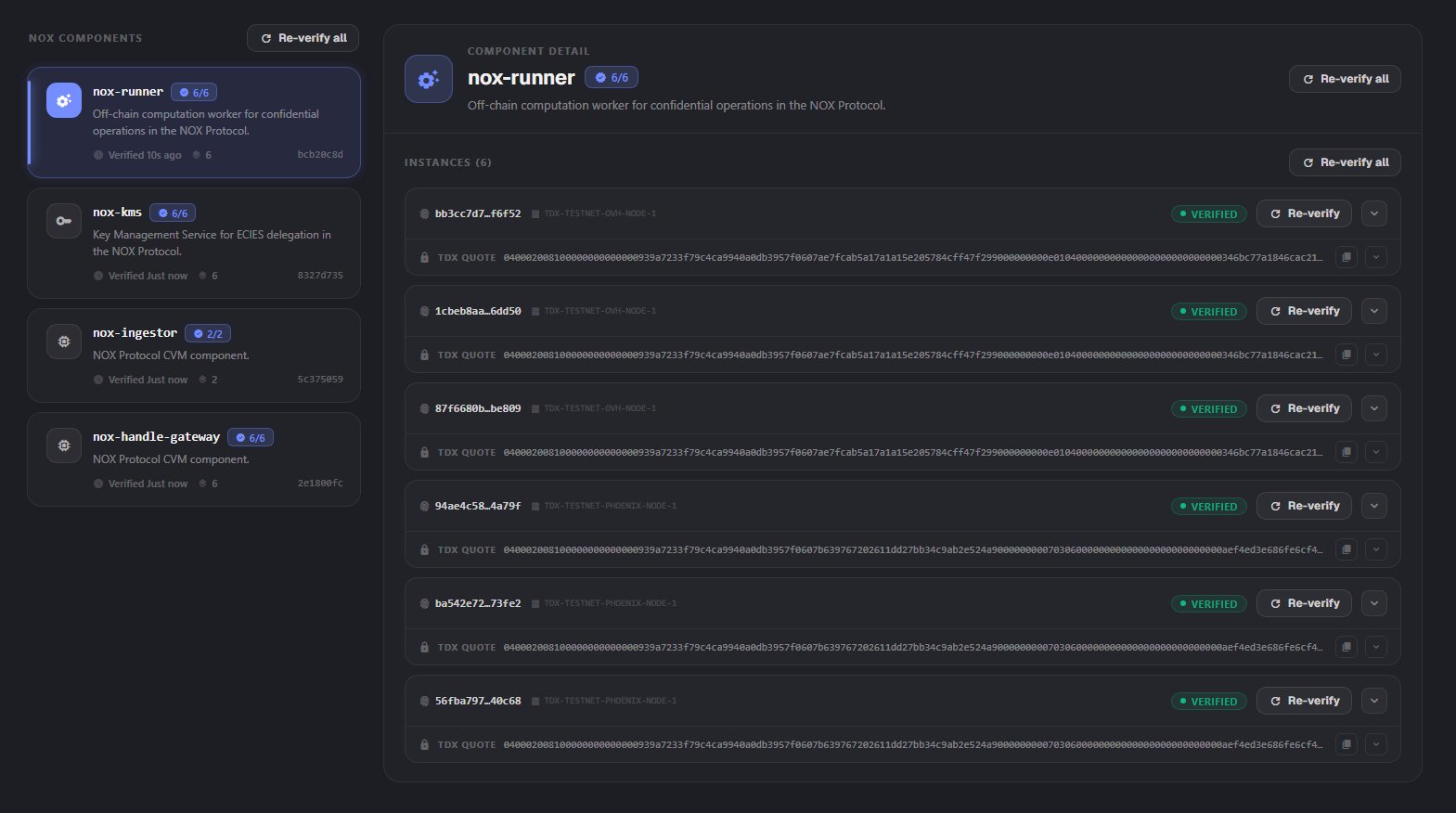
The tweet emphasizes that iExec and Phala Network provide verifiable privacy computing through runtime attestation, which is crucial for institutional-grade applications.
DeFi Warhol
OnChain_Analyst
DeFi_Expert
B
44.5K @Defi_Warhol Crypto loves the word "trustless".
IMO, private computation should never require blind trust.
If a system hides balances, positions, or business logic, users still need proof that it's running the code it claims to run.
That's what runtime attestation does. A few privacy systems expose it:
1. @iEx_ec
Exposes it through a live attestation UI for its Nox stack.
2. @PhalaNetwork
Runs a public trust center for checking its confidential machines.
iExec's version lets anyone check a live system and confirm that:
→ It's running on genuine Intel TDX hardware
→ The code and config match exactly what was claimed
→ The proof is fresh (not a replay of an earlier one)
You can run these checks yourself in your browser without relying on the project’s claims. None of it exposes private data.
This flow is especially important for institutions, who aren't going to invest in a private system before verifying it themselves.
As a long-time iExec and crypto supporter, "don't trust, verify" is a lifestyle, not just a fan
 73
73
 33
33
 7.3K
7.3K
2026-07-29 20:42
Tendencia de RLC tras el lanzamiento
Alcista
The tweet emphasizes that iExec and Phala Network provide verifiable privacy computing through runtime attestation, which is crucial for institutional-grade applications.
DeFi Warhol
OnChain_Analyst
DeFi_Expert
B
44.5K @Defi_Warhol Alcista
The tweet emphasizes that iExec and Phala Network provide verifiable privacy computing through runtime attestation, which is crucial for institutional-grade applications.
Crypto loves the word "trustless".
IMO, private computation should never require blind trust.
If a system hides balances, positions, or business logic, users still need proof that it's running the code it claims to run.
That's what runtime attestation does. A few privacy systems expose it:
1. @iEx_ec
Exposes it through a live attestation UI for its Nox stack.
2. @PhalaNetwork
Runs a public trust center for checking its confidential machines.
iExec's version lets anyone check a live system and confirm that:
→ It's running on genuine Intel TDX hardware
→ The code and config match exactly what was claimed
→ The proof is fresh (not a replay of an earlier one)
You can run these checks yourself in your browser without relying on the project’s claims. None of it exposes private data.
This flow is especially important for institutions, who aren't going to invest in a private system before verifying it themselves.
As a long-time iExec and crypto supporter, "don't trust, verify" is a lifestyle, not just a fan
73
33
7.3K
2026-07-29 08:27
Tendencia de RLC tras el lanzamiento
Alcista
The tweet emphasizes that iExec and Phala Network provide verifiable privacy computing through runtime attestation, which is crucial for institutional-grade applications.

The Boss
TA_Analyst
Trader
B
89.3K @CryptoTheBossX Alcista
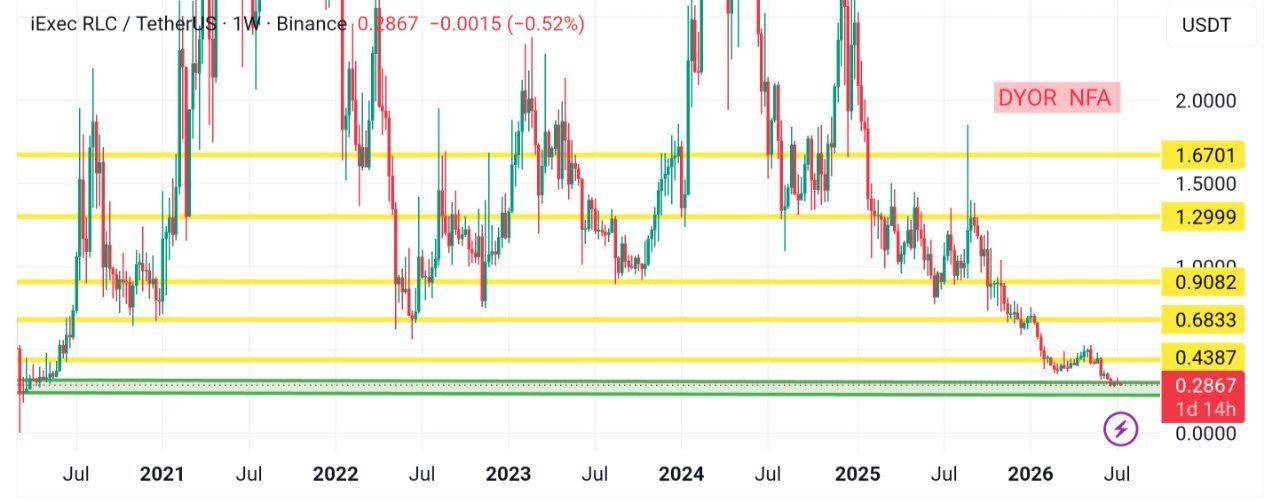
RLC is bottoming in a historic demand zone, selling pressure is easing, making it suitable for accumulation.
🔍 Some charts tell their story through momentum. Others tell it through silence.
$RLC has spent months drifting lower, but the latest weekly candles reveal something different. Price is no longer accelerating into fresh lows instead, it's compressing on top of a historical demand zone that has acted as a turning point before. When volatility contracts after an extended decline, the market is often deciding whether to continue the trend or begin building a new foundation.
There isn't enough evidence to call this a reversal yet. The broader structure remains bearish until buyers reclaim the first major resistance, but the inability of sellers to extend the decline is becoming increasingly noticeable. RSI would naturally be expected to stabilize after such a prolonged sell-off, while MACD momentum gradually flattens as bearish pressure weakens. For now, this is a chart worth watching for accumulation not chasing for confirmation. ⚖️
⚠️ Not financial advice.
#Bitcoin #Ethereum #Altcoins #Crypto
 231
45
14.0K
231
45
14.0K
2026-07-18 10:27
Tendencia de RLC tras el lanzamiento
Alcista
RLC is bottoming in a historic demand zone, selling pressure is easing, making it suitable for accumulation.
Predicción de precios
¿Cuándo es un buen momento para comprar RLC? ¿Debería comprar o vender RLC ahora?
Al decidir si es un buen momento para comprar o vender iExec RLC (RLC), es importante ajustarse primero a su propia estrategia de trading y perfil de riesgo. Los inversores a largo plazo y los traders a corto plazo suelen interpretar las condiciones del mercado de forma diferente, por lo que su decisión debe reflejar su enfoque personal. Según el último análisis técnico de 4 horas de RLC, la señal de trading actual es Comprar. Según el último análisis técnico de 1 día de RLC, la señal actual es Hold.

Predicción de Beacon
Pronóstico probabilístico de precios (próximas 24 horas)Descargo de responsabilidad de la predicción de Beacon
Los resultados de los datos que se muestran en esta página se analizan en función de los datos de trading reales (OHLCV) del par de trading seleccionado junto con los indicadores técnicos correspondientes.
Esta predicción es un producto técnico experimental y se proporciona solo con fines de referencia. No constituye un consejo de inversión. Los acontecimientos inesperados del mundo real pueden influir significativamente en el comportamiento del mercado. Por tanto, los traders deben tomar decisiones con precaución.
Esta predicción es un producto técnico experimental y se proporciona solo con fines de referencia. No constituye un consejo de inversión. Los acontecimientos inesperados del mundo real pueden influir significativamente en el comportamiento del mercado. Por tanto, los traders deben tomar decisiones con precaución.
Sobre iExec RLC
iExec RLC (RLC) is a cryptocurrency launched in 2017and operates on the Ethereum platform. iExec RLC has a current supply of 86,999,784.98684549. The last known price of iExec RLC is 1.08122917 USD and is up 2.41 over the last 24 hours. It is currently trading on 189 active market(s) with $99,474,384.65 traded over the last 24 hours. More information can be found at https://iex.ec/.
Leer más
Enlaces oficiales
Explorador de blockchain