Acheter des cryptomonnaies
carte
P2P Trading
Achetez des USDT sur la marketplace
Carte bancaire
Achetez des cryptomonnaies avec une carte Visa ou Mastercard
Paiement par un tiers
Buy des crypto via MoonPay, Simplex et plus
BitMart Card
Dynamisez vos investissements dans les cryptos
Carte prépayée crypto
Obtenez instantanément une Mastercard prête à l'emploi
Échanger
Spot
Négociez des cryptomonnaies rapidement et de manière professionnelle
BM Discovery
La plateforme de découverte d'actifs On-Chain la plus rapide
DEX
bêta
La solution la plus simple pour trader en chaîne.
Marge
5x
Augmentez vos profits grâce à l'effet de levier
Pré-marché
Planifiez à l'avance, saisissez l'opportunité
USDⓈ-M
En utilisant USDⓈ comme garantie
COIN-M
Utiliser la cryptomonnaie elle-même comme garantie
TradFi
Un guichet unique pour les métaux, les actions et le forex
Démo de trading
Apprenez à trade sans risque
Aperçu des contrats à terme
Une plateforme unique pour tout ce qui concerne les contrats à terme
Futures King
Cagnotte de 478 000 USDT
Augmenter
Aperçu des gains
Actifs inactifs, obtenez des rendements en toute simplicité
Épargne
Gagnez des intérêts grâce à vos avoirs.
Staking
Staking facile, récompenses élevées
Gestion de patrimoine
Développez votre patrimoine avec une équipe d'actifs de premier ordre Top
RWA
Conservez le BMRUSD et profitez du rendement
Offre exclusive pour les VIP
Gagner en toute sécurité pour les utilisateurs VIP
Rewards
Centre de récompenses
Découvrez des récompenses exclusives d'une valeur allant jusqu'à 14 000 USDT
Lancement Prime
Une plateforme de lancement de jetons et NFT
Programme d'affiliation
Rejoignez-nous pour profiter de commissions élevées
Powerdrop
La solution airdrop de nouvelle génération est DISPONIBLE !
Centre des événements
Le guichet unique pour toutes les opérations commerciales
Tirage au sort quotidien futures
100% de chances de gagner avec les tradings quotidiens
Tirage quotidien Spot
Gagnez 8 888 USDT en grands prix
Staker pour voter
Gagnez des airdrops en votant
Institution
Des services professionnels et exclusifs
VIP
Débloquez des récompenses exclusives
Académie
Tout ce que vous devez savoir sur le trading et la blockchain.
Stage chez BitMart
Commencez votre carrière en crypto ici
Bitmart Travel
Services de voyage mondiaux One-Stop
INO
Une plateforme de lancement de NFT
Stake BMX pour le listing
Partager les frais de transaction
APIS
Une stabilité fiable et de nombreux points de terminaison
Programme de courtier
Gagnez des commissions grâce à l'intégration d'API
Actualités
Dernières actualités et derniers points de vue
MARKETPLACE NFT
Une marketplace NFT unique en son genre
Recharge mobile Top
Rechargez vos téléphones portables facilement, online, en toute sécurité
Send
Send money globally, fast and secure
BitMart Mall
Événement en direct sur les cryptomonnaies

Lido wstETH (WSTETH)
$ 3,339.79 (WSTETH/USD)
-0.43%
24H
Lido wstETH Données sur les prix en temps réel
Le prix de Lido wstETH aujourd'hui est $ 3,339.79 (WSTETH/USD). Avec une capitalisation boursière de $ 12.72B USD. Volume de trading de $ 8.20M USD sur 24 heures, Un changement de prix de -0.43% sur 24 heures, Et une réserve circulante de 3.81M WSTETH.
Lido wstETH WSTETH Historique des prix USD
Suivez le prix de Lido wstETH aujourd’hui, dans 7 jours, 30 jours et 90 jours
Période
Modifier
Variation (en pourcentage)
Aujourd'hui
$ 14.53
-0.43%
7Jours
$ 97.96
3.01%
30Jours
$ 248.69
8.02%
90Jours
$ 1,413.05
72.92%
Possédez WSTETH dès maintenant
Achetez et vendez WSTETH facilement et en toute sécurité sur BitMart.
Lido wstETH Informations sur le marché
$ 3,337.06 Fourchette de prix sur 24 heures $ 3,391.98
Record absolu
$ 6,450.79
Plus bas niveau jamais atteint
$ 894.01
Variation sur 24 heures
-0.43%
Volume sur 24 h
$ 8,199,635.44
Approvisionnement en circulation
3.80M
WSTETH
Capitalisation boursière
$ 12.72B
Approvisionnement maximal
--
Capitalisation boursière entièrement diluée
$ 12.72B
Trader WSTETH
Gagner
Faites fructifier vos cryptomonnaies et générez des revenus passifs grâce à l'épargne, au staking, et plus encore.
Lido wstETH X Insight

Bubbafox
FA_Analyst
Influencer
B
 26.4K @bob4punk
 Neutre
CCIP transfers $13.1M, wstETH leads, encourages staking LINK.

CCIPMetrics D
3.8K @CCIPMetrics #CCIP today
Value transferred: $13,148,079.2
Top sent token: $wstETH @LidoFinance: $3,513,052.7 (26.7%)
Transactions: 1,820
Fees: $1,916.9
Top sender: @Predictstreet: Tx: 872 (47.9%), Fees: $1,431.8 (74.7%)
Pools open. Stake your LINK today at https://t.co/yhMFfpGi0K
 124
124
 9
9
 6.0K
6.0K
2026-07-12 00:57
Tendance de WSTETH après le lancement
Neutre
CCIP transfers $13.1M, wstETH leads, encourages staking LINK.

StakingCabin
OnChain_Analyst
Tokenomics_Expert
B
2.8K @stakingcabin Haussier
wstETH can be bridged to Robinhood, continuing to earn ETH staking rewards
One of the biggest challenges in DeFi is fragmented liquidity.
By enabling wstETH to move to Robinhood Chain while continuing to accrue staking rewards, capital can flow into a new ecosystem without sacrificing its underlying yield.

Lido D
228.8K @LidoFinance Staked ETH, meet Robinhood Chain.
Your wstETH can now cross over to @RobinhoodCrypto, carrying its Ethereum staking rewards with it and unlocking a new ecosystem to put it to work in.
↓ https://t.co/23u0Vlp9rE
1
0
110
2026-07-07 14:27
Tendance de WSTETH après le lancement
Haussier
wstETH can be bridged to Robinhood, continuing to earn ETH staking rewards

Mars_DeFi
Researcher
Educator
B
26.2K @Mars_DeFi Extrêmement haussier
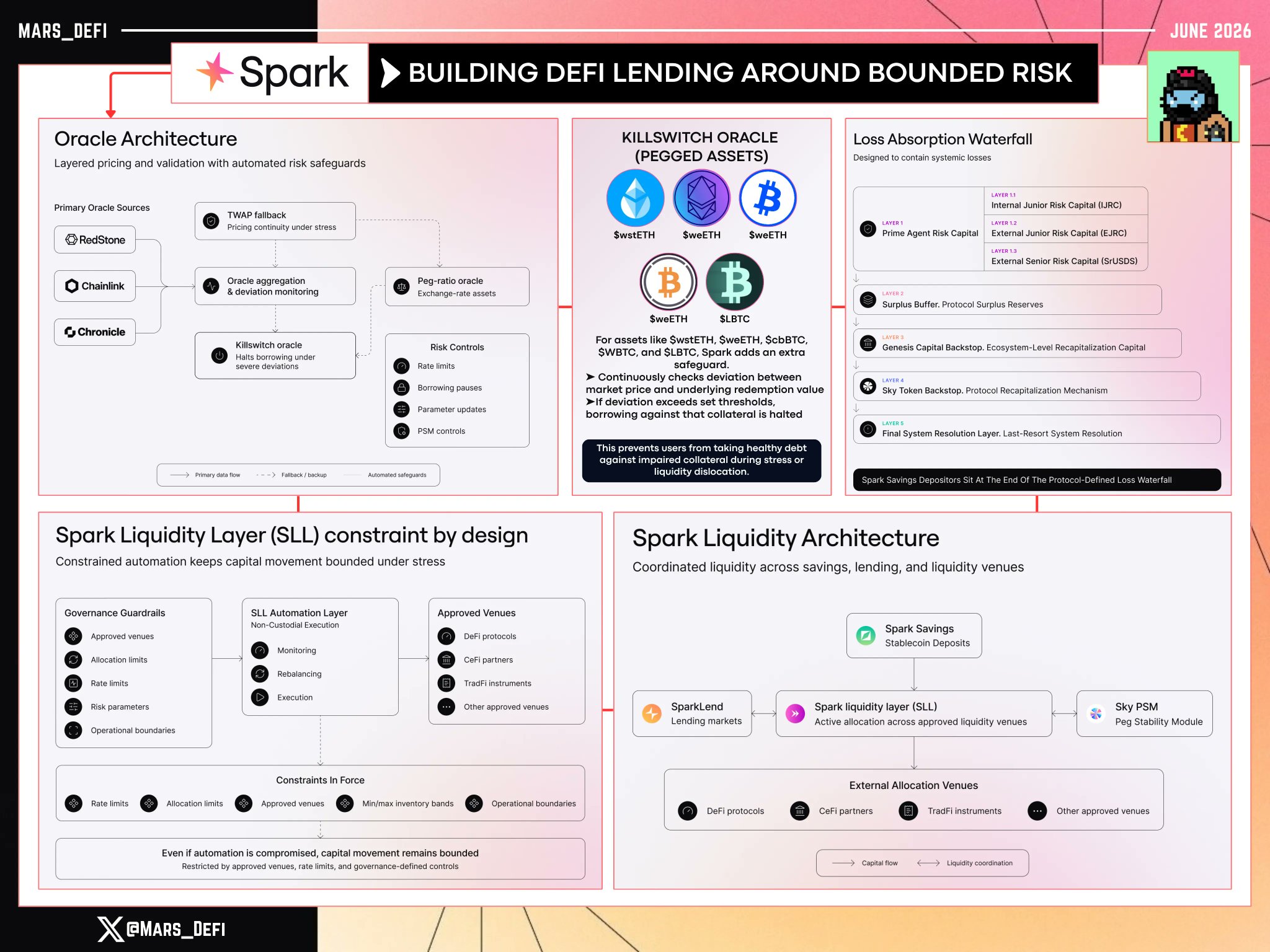
Spark builds a safe and robust DeFi lending infrastructure through multi‑layer risk control, oracles, and liquidity management.
Most lending markets optimize for liquidity and capital efficiency first, then try to manage risk after the fact while @sparkdotfi ’s security/risk framework is one of the better examples of where DeFi lending is heading.
The whole architecture is built around bounded risk, controlled capital movement, layered loss absorption, oracle redundancy, and stress-response mechanisms.
Here’s how Spark does it.
—
Spark keeps a deliberately narrow collateral set, which reduces exposure to fragmented liquidity, weak redemption assumptions, and long-tail collateral risk.
Instead of trying to list every possible asset, it prioritizes predictable liquidation behavior and deeper market structure during stress.
For assets with more unique or chain-specific risks, Spark uses isolated markets. That means risk can be priced more precisely per collateral type, and a single collateral issue does not automatically contaminate the broader pool.
—
The oracle setup is also important.
Spark uses a three-oracle median system drawing from @redstone_defi , @chainlink , and @ChronicleLabs oracle.
When all three return valid prices, the median is used. If only two valid sources are available, the average is used, with fallback logic under degraded conditions.
That reduces dependency on any single oracle provider.
For pegged or exchange-rate assets like $wstETH, $weETH, $cbBTC, $WBTC, and $LBTC, Spark adds another layer through a killswitch oracle.
• This continuously checks whether market pricing is diverging from the underlying exchange-rate or redemption value.
• If deviation passes predefined thresholds, Spark can halt new borrowing against that collateral.
That is a very important safeguard because it prevents users from borrowing healthy debt against impaired collateral during periods of stress, liquidity fragmentation, or pricing dislocation.
—
The liquidity architecture is another strong part of the design.
Spark’s Liquidity Layer is not just idle capital sitting passively in a pool. It coordinates liquidity across Spark Savings, SparkLend, the Sky PSM, and other approved venues.
But the key part is that this liquidity movement is constrained by design.
All venues must be pre‑approved by governance. Capital movement is subject to;
• allocation limits
• rate limits
• min/max inventory bands
• risk parameters
• operational boundaries
Spark’s framework is built around controlled risk, not unlimited automation.
Capital can only move through approved venues, rate limits, allocation limits, and governance‑defined boundaries. So even if automation fails, the damage is contained.
The same idea applies to losses.
Before depositors are affected, losses pass through multiple buffers: risk capital, surplus buffer, Genesis Backstop, SKY backstop, and final resolution.
Spark Savings also has 1:1 USDS backing, liquidity buffers, fast withdrawal routing, real-time transparency, Credora risk reviews, and limited bridge exposure.
—
Overall, the theme is simple:
Spark is not just chasing higher yields.
It is building DeFi credit infrastructure around constrained liquidity, layered protection, and limited blast radius.

Spark D
69.7K @sparkdotfi Inside Spark’s loss absorption & risk frameworks.
Spark’s security architecture is designed around:
• bounded capital movement
• explicit loss absorption layers
• coordinated liquidity management
• multi-layered oracle systems
• constrained automation under governance-defined limits
This deep dive breaks down how Spark structures risk, liquidity, and loss absorption across Spark Savings, SparkLend, and the Spark Liquidity Layer before losses propagate toward user deposits.
Including:
• updated loss absorption waterfall
• Prime Agent risk capital
• Genesis Capital Backstop
• oracle and killswitch architecture
• programmatic liquidity coordination
• constrained allocation design under stress
Security by design.
Resilience by architecture.
See what sits between losses and user deposits: https://t.co/JQrfSxMB4z
30
18
1.7K
2026-06-03 14:12
Tendance de WSTETH après le lancement
Extrêmement haussier
Spark builds a safe and robust DeFi lending infrastructure through multi‑layer risk control, oracles, and liquidity management.
Prévision de prix
Quel est le meilleur moment pour acheter WSTETH? Dois-je acheter ou vendre WSTETH maintenant ?
Pour déterminer s'il est opportun d'acheter ou de vendre Lido wstETH (WSTETH), il est important de commencer par s'aligner sur sa propre stratégie de trading et son profil de risque. Les investisseurs à long terme et les traders à court terme interprètent souvent les conditions du marché différemment, votre décision doit donc refléter votre approche personnelle. Selon la dernière analyse technique WSTETH de 4 heures, le signal de trading actuel est Vendre. Selon la dernière analyse technique WSTETH sur 1 jour, le signal actuel est Tenez.

Prédiction de Beacon
Prévision probabiliste des prix (Prochaines 24 heures)Avertissement de prédiction de Beacon
Les résultats affichés sur cette page sont analysés sur la base des données de trading réelles (OHLCV) de la paire de trading sélectionnée ainsi que des indicateurs techniques correspondants.
Cette prédiction est un produit technique expérimental et est fournie uniquement à titre de référence. Ceci ne constitue pas un conseil en investissement. Des événements inattendus du monde réel peuvent avoir un impact significatif sur le comportement du marché. Les traders doivent prendre des décisions avec prudence.
Cette prédiction est un produit technique expérimental et est fournie uniquement à titre de référence. Ceci ne constitue pas un conseil en investissement. Des événements inattendus du monde réel peuvent avoir un impact significatif sur le comportement du marché. Les traders doivent prendre des décisions avec prudence.
À propos Lido wstETH
Lido wstETH (WSTETH) is a cryptocurrency launched in 2020and operates on the Ethereum platform. Lido wstETH has a current supply of 3,807,834.45169063. The last known price of Lido wstETH is 3,305.89974941 USD and is up 1.19 over the last 24 hours. It is currently trading on 798 active market(s) with $6,757,557.09 traded over the last 24 hours. More information can be found at https://www.lido.fi.
En savoir plus