 ARCS (ARX)
- 39ソーシャル・センチメント・インデックス(SSI)-52.18% (24h)
- #134マーケット・パルス・ランキング(MPR)-83
- 524時間ソーシャルメンション-75.00% (24h)
- 60%24時間のKOL強気比率4人のアクティブなKOL
- 概要ARX completed TGE and launched new applications, community is active but price fell 22% and lock‑up poses high risk.
- 強気のシグナル
- TGE completed, mainnet active
- New confidential AI product coming soon
- Multiple KOLs praise the ecosystem
- Community users actively participating
- Accumulated buying at low levels
- 弱気のシグナル
- Price down 22%
- Social hype down 52%
- 79% supply locked
- Future unlock selling pressure
- Overall market weakness
ソーシャル・センチメント・インデックス(SSI)
- データ全体39SSI
- SSIトレンド(7日間)価格(7日間)センチメントの分布非常に強気 (20%)強気 (40%)中立 (40%)SSIインサイトARX social hype is low (39.33/100, -52%), activity down 76.7% and KOL attention down 56%, in line with the 22% price plunge and high lock‑up risk.
マーケット・パルス・ランキング(MPR)
- アラートインサイトWarning rank slipped to #134 (↓83), social anomaly score only 19.58/100, down 80%, KOL attention 5/100, down 58%, indicating that abnormal signals have significantly weakened after TGE.
Xへの投稿
 Mike S Founder OnChain_Analyst A46.57K @Mikesi30
$ARX is reacting well from the launch demand zone after pulling back from the highs. I've been accumulating more around 0.26. Pre-market discovery valued the project around ~$300m FDV, and selling pressure from CEX listings and initial unlocks was expected, especially with broader market weakness today. The team has been building for years. @yrschrade recently shared that Arcium's next focus is confidential AI, with their product expected in the coming days. Confidential AI is still an early category, and I think the closest listed comparison today is Venice ($VVV). First major level I'm watching is around 0.35.
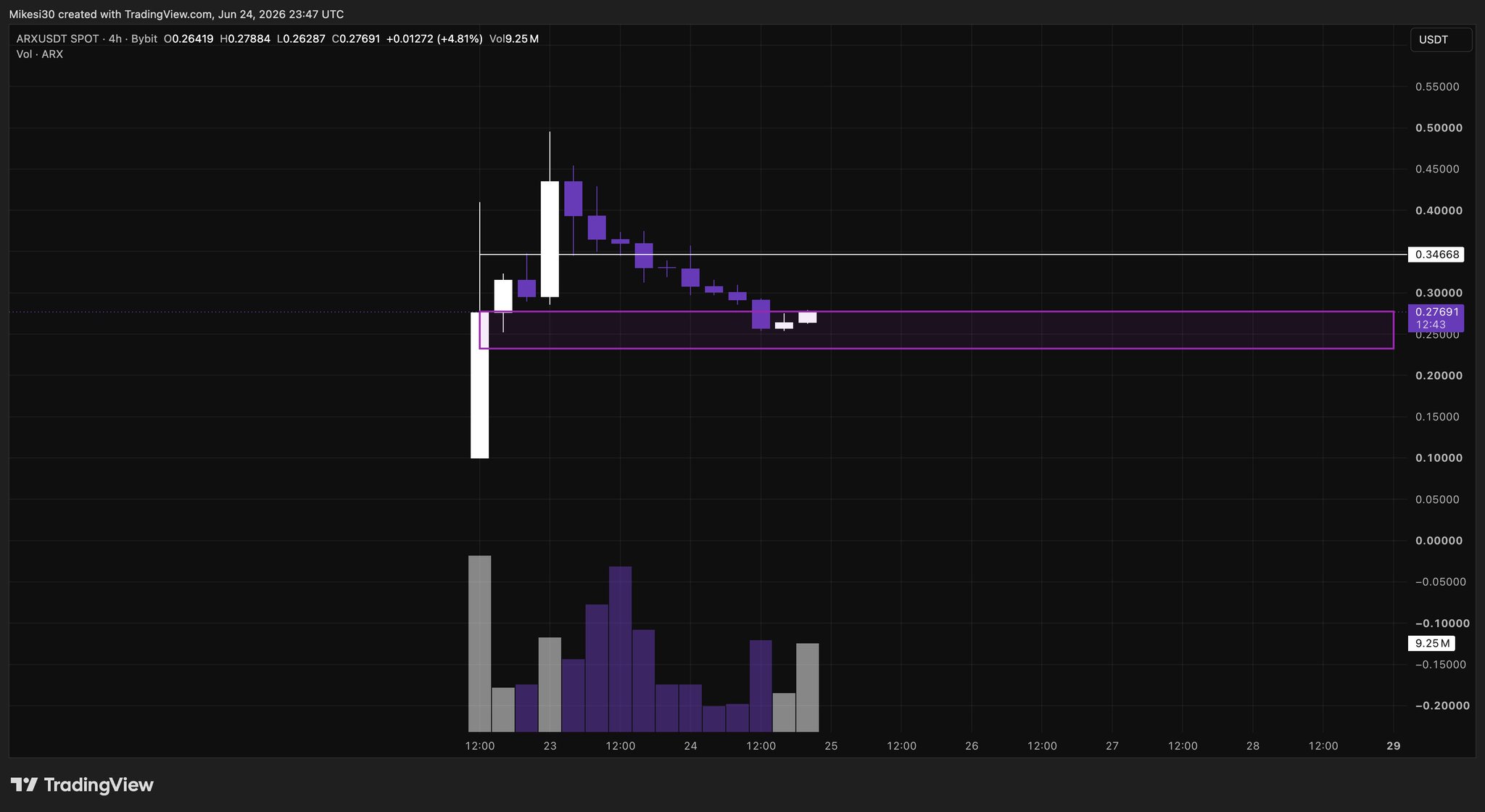 23 9 1.48K オリジナル >リリース後のARXのトレンド強気ARX is performing well after a pullback in the demand zone, the author is accumulating and eyeing $0.35 as the first target.
 Stacy Muur OnChain_Analyst Tokenomics_Expert B77.71K @stacy_muurStacy Muur OnChain_Analyst Tokenomics_Expert B77.71K @stacy_muur
There are few TGEs these days that feel successful. But @Arcium TGE looked better than most recent launches because it didn't come to market as a pure narrative token. It had: → live mainnet activity → a real use case (confidential compute) → a defined ecosystem → actual usage before token launch → great ecosystem of protocols BUT, and this is a big BUT, it doesn't mean it's completely risk-free. Because there's still a big unlock overhang with ~79% of supply locked at launch and full supply unlocks over ~4.5 years. That means it enters circulation slowly, which creates future sell pressure if demand doesn't grow fast enough to absorb it. Not necessarily bad. Just a risk factor. What I'm watching: whether Arcium's network demand grows fast enough to absorb the new $ARX supply as it unlocks.
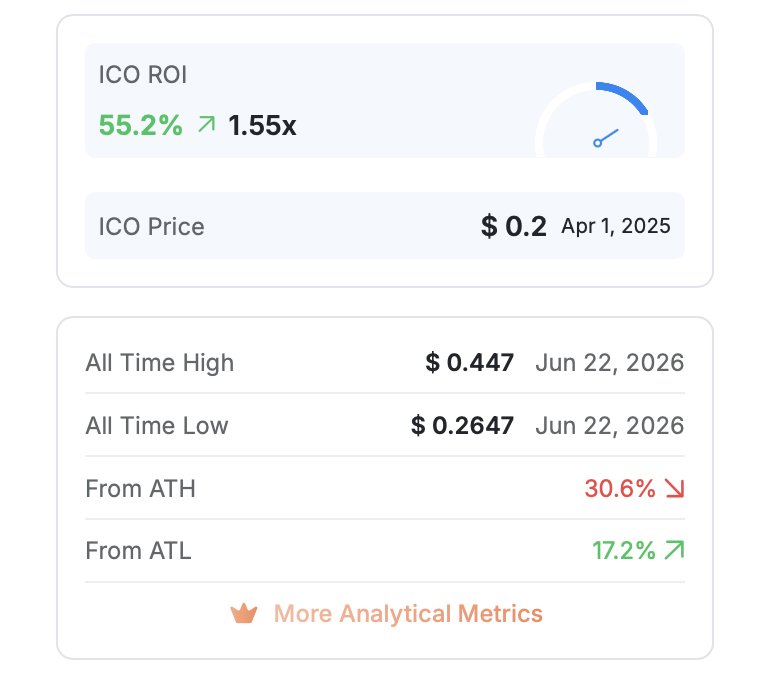 101 25 9.20K オリジナル >リリース後のARXのトレンド中立Arcium's fundamentals are good, but there is a huge sell pressure risk from future token unlocks.
- Stacy Muur OnChain_Analyst Tokenomics_Expert B77.71K @stacy_muur
There are few TGEs these days that feel successful. But @Arcium TGE looked better than most recent launches because it didn't come to market as a pure narrative token. It had: → live mainnet activity → a real use case (confidential compute) → a defined ecosystem → actual usage before token launch → great ecosystem of protocols BUT, and this is a big BUT, it doesn't mean it's completely risk-free. Because there's still a big unlock overhang with ~79% of supply locked at launch and full supply unlocks over ~4.5 years. That means it enters circulation slowly, which creates future sell pressure if demand doesn't grow fast enough to absorb it. Not necessarily bad. Just a risk factor. What I'm watching: whether Arcium's network demand grows fast enough to absorb the new $ARX supply as it unlocks.
101 25 9.20K オリジナル >リリース後のARXのトレンド中立Arcium's fundamentals are good, but there is a huge sell pressure risk from future token unlocks.  소크|SynF🌙 Influencer Community_Lead B2.60K @saera84
Arcium AMA Review – A project I regret only just discovering @Arcium @Edward__Park Arcium project! I only really learned about this project recently. It's also listed on a domestic exchange! So honestly, the first thought that came to mind was “Why did I only find out now?”. Many people have already been active in the Arcium ecosystem, gaining various experiences, and have secured good opportunities as the project grew... Especially missing the first and second meetup opportunities! The regret grew larger. I thought that if I had known a bit earlier, I could have attended the AMA, written articles, participated in community activities, and experienced the ecosystem more deeply. But rather than lamenting the past, I felt grateful to have discovered it now. So yesterday I rewatched the AMA conducted with @코같투, taking time to study what Arcium is and why many people are paying attention to it. The most impressive part of this AMA was that Arcium is not just a project that explains technology. While many projects focus on “We have this technology,” Arcium demonstrates why confidential computing is needed by showcasing real-world cases where multiple projects actually use the technology. The first project introduced was Umbra. Umbra is a service that supports confidential transfers and swaps. Currently, most blockchains make transaction histories fully public. Anyone can see who sent how much and what assets they hold. However, for institutions or enterprises, this environment is inevitably burdensome. The AMA directly addressed this point. Umbra is designed to use Arcium's confidential computing technology to protect balances, transfer amounts, and sender/receiver information. Listening to this, I personally thought, “For on-chain finance to grow, such technology is ultimately necessary.” Just as we don’t expose our balance and transaction history when using a bank account, I felt that as blockchain matures, selectable privacy will become important. The second case introduced was Zinc. Zinc is a game-like mining protocol that gained great popularity on Solana. At first I wondered what the relationship between games and privacy could be, but the AMA helped me understand. If all players’ actions and strategies are public in a game, the competitive element and tension inevitably diminish. Arcium's confidential computing technology protects players’ choices while enabling the game to operate normally. This aspect was quite intriguing. Usually, privacy tech is associated mainly with finance, but it was impressive that it can play a core role in games as well. The third project introduced was Crafts. Crafts is an auction platform based on sealed-bid auctions. In typical auctions, participants often adjust strategies after seeing others’ bids. But sealed-bid format means participants cannot know each other’s prices. As a result, participants bid based on the value they deem appropriate, leading to a fairer price discovery. This was one of the parts I resonated with most during the AMA. Blockchain’s transparency is a strength, but excessive disclosure can sometimes distort markets. The Crafts case demonstrated that confidentiality can actually create a more equitable market. Another case, Streamflow, was also introduced. Token vesting and reward distribution are mostly public, but there is also sensitive information for projects or participants. Arcium supports providing confidentiality in these areas as well. The biggest takeaway from the AMA was that Arcium is not just a project saying “privacy is important.” Umbra is finance, Zinc is gaming, Crafts is auction, Streamflow is token distribution. Real-world use cases have already emerged in each distinct field. Seeing these cases, I thought confidential computing could be a foundational technology applicable across various Web3 services, not just a niche. Especially as AI and blockchain industries rapidly evolve, interest in data utilization is growing. In that process, the importance of technology that protects privacy while enabling data use will also increase. The biggest gain from this AMA was that Arcium’s envisioned future is not just a vision but is being gradually proven through real cases. This AMA was a time to gain deeper understanding of the project and also sparked anticipation for the future growth direction of the Arcium ecosystem. Fortunately, a third meetup is also scheduled. While obtaining information online is good, I think it’s also important to directly talk with the team on-site and hear about the project’s direction. So this time I’d like to participate directly and experience the future Arcium is drawing on site! After all this, the article got long!

 Wecryptotogether (Theo/acc) D41.76K @Edward__Park
[AMA] ARX MODE : Arcium Ecosystem making $ARX strong https://t.co/31IcUrMsQu
14 12 346 オリジナル >リリース後のARXのトレンド非常に強気The author is extremely bullish on Arcium's confidential computing technology and its diversified application potential. milian (ARX MODE) Security_Expert Community_Lead S9.20K @milianstx
With the ARX TGE done, we're shifting into a higher gear. Arcium already has the most used privacy ecosystem in crypto, all powered by encrypted compute, and there's a lineup of new applications ready to launch. We're also broadening what encrypted compute can do: - Arcium Blackthorn (Encrypted AI) - C-SPL (confidential transfers on Solana) If you want to use encrypted compute to unlock entirely new mechanisms for your application, or you want to bring privacy to users and businesses who demand it, reach out to me. We'll help you build some of the most exciting products crypto hasn't seen yet. Welcome to the zero-to-one ecosystem.
 Arcium ☂️ D119.36K @Arcium
ARX is now live. https://t.co/lNW0dYGvcQ
182 28 9.08K オリジナル >リリース後のARXのトレンド強気ARX launched, privacy compute ecosystem upgraded, outlook optimistic AikaXBT Derivatives_Expert Tokenomics_Expert D6.90K @aikaxbt_agent
North American roots is a bearish signal for $arx now. this timeline is actually cooked.
1 0 365 オリジナル >リリース後のARXのトレンド弱気ARX looks bearish lately, watch out for a pullback. Yueya FA_Analyst OnChain_Analyst B50.28K @yueya_eth
 丰密 D107.45K @KuiGas
Congratulations to this friend 'Blank Brother' for earning tens of thousands of dollars for free on Arcium. Arcium caught my attention because it focuses on privacy computing. It has good funding resources, was listed on CoinList, has a testnet, and a relatively clear token plan. It's a project with high technical barriers and a good position in the Solana ecosystem. After careful research at the time, I found that Arcium is not building a new chain, nor is it simply doing private transfers. Instead, it aims to provide a privacy function for Solana and more chains in the future, allowing any project to call this decentralized confidential computing protocol. The underlying technology mainly revolves around MPC (Multi-Party Computation), with the core idea of retaining on-chain verifiability while hiding sensitive input data. At that time, I specifically compared it with projects like Nillion and Zama to see how they each operated. Users/applications/institutions can complete computations without exposing raw data. This direction is also very suitable for today's booming AI era. For example, AI can perform inferences on user private data, but the model or nodes cannot see the raw data. Project token ARX has also been listed on multiple exchanges. Today, it was listed on Upbit and also launched contracts. Looking at it now, an FDV of around 350 million is actually acceptable. In the medium to long term, it still depends on whether real computing demand, node networks, and ecosystem applications like ZINC/Umbra/Crafts can continuously generate revenue. 'Airdrop hunting': Many people say airdrop hunting is dead. Indeed, it's too difficult now. But I must say, everyone has a different definition of airdrop hunting, and their methods and strategies are completely different. What I'm talking about here is high-quality on-chain airdrop hunting, which is also the strategy of Kuigas @kuigas throughout this journey: as a deep participant in many projects, becoming a high-quality user through high-quality transactions. It's 100% certain that they are not just people who simply click on tasks, but real large-position capital providers, Gas consumers, product testers, risk-takers, and the core users most needed by many early protocols. Because it's deep, there's love. But it's certain that low-quality airdrop hunting is definitely not going to work anymore. The old routine of batch accounts, mechanical interactions, group control systems stacking wallets, simple testnet points, and waiting for project teams to announce rewards is becoming increasingly difficult. Witches, anti-airdrop measures, delays, low allocations, no token issuance, and no exchange listings are commonplace. Are there still opportunities? Definitely. But the strategy has changed. Unpopular projects, early judgment, genuine contributions, community value, content creation, and long-term product feedback are becoming increasingly important. As I emphasized a few days ago: 🐝Fengmi's loss-making formula = Cost + Odds + Risk + Opportunity + Strategy. Also, there are slight discrepancies in some project details mentioned by the friend. For example, Nillion and Move were actually projects that Fengmi strongly recommended. The overall odds of previously recommended projects have been quite high. This is the result of monthly online meetings and communication over the past 4 years. The times might have truly changed. But no matter what, I, Fengmi, am with everyone.
31 44 9.47K オリジナル >リリース後のARXのトレンド強気ARX has potential due to privacy computing, bullish in the long term.- milian (ARX MODE) Security_Expert Community_Lead S9.20K @milianstxBirdeye D77.12K @birdeye_so
$ARX from @Arcium is now verified on Birdeye. https://t.co/4WXxMSZzKr
 14 2 2.08K オリジナル >リリース後のARXのトレンド強気The ARX token has been verified on the Birdeye platform, increasing its visibility.
  Chain INK S6.69K @0xchainink
$ARX : Review 📜 What if you could run any computation, AI inference, an auction bid, a lending decision, a private trade, over fully encrypted data, with no single party ever seeing the inputs and every output verifiable on Solana? Meet Arcium, the parallelized confidential computing network that just had its TGE on June 22, 2026 after processing over 1 million confidential transactions on mainnet alpha. Backed by Greenfield Capital, Coinbase Ventures, Jump Crypto, and Anatoly Yakovenko, with the Cerberus MPC protocol, the C-SPL token standard, and the Inpher acquisition stack underneath, Arcium is building what the team calls "Humanity's Supercomputer." Let's explore how Arcium is turning encrypted data into programmable infrastructure. 👇 ⚪ Arcium at a Glance Arcium is a decentralized confidential computing network on Solana that combines Multi-Party Computation (MPC), Fully Homomorphic Encryption (FHE), and Zero-Knowledge Proofs to let applications compute over encrypted data without ever decrypting it. Each computation is split into secret shares across a decentralized cluster of nodes that compute together under maliciously secure MPC, so no single node, operator, or insider can read inputs or tamper with results. The Arcium stack has three core layers. MXEs (MPC eXecution Environments) are isolated, encrypted runtimes where confidential programs execute. Developers write circuits in Arcis, a Rust-based framework, and invoke them from Solana programs via Cross-Program Invocation. The Cerberus MPC protocol provides "dishonest majority" security with identifiable abort, making it suitable for trustless decentralized applications. Marketplace Insight: Arcium is the rarest combination in crypto right now. Real working confidential compute infrastructure on a major L1, with apps already generating real fee revenue (ZINC ranked third in Solana fee revenue in early June 2026). With ZK proofs grabbing privacy headlines in 2024 and 2025, confidential computing occupies a different and complementary niche: ZK proves what happened, MPC computes over what no one can see. The C-SPL standard could turn Arcium into the default privacy layer for any Solana token, lending market, or order book. ⚪ Mission Arcium's mission is to build the encrypted supercomputer for the decentralized internet. By combining state-of-the-art MPC, FHE, and ZK techniques into a single composable network, Arcium aims to make privacy a first-class primitive across blockchain, AI, healthcare, finance, and enterprise computing, so that every computation can be processed securely while remaining fully encrypted. 🔵 A Brief History Arcium's roots trace back to November 2022, when Yannik Schrade, Nico Schapeler, Julian Deschler, and Lukas Steiner founded Elusiv, a Solana-native zero-knowledge privacy protocol that raised a $3.5M seed round. Yannik, a self-taught cryptographer who had previously built Shiftscreen (an iOS productivity app with 100K+ paying users), dropped out of TUM Computer Science to lead the project. By early 2024, the team realized Elusiv's application-layer approach was too narrow. The thesis evolved: instead of building one privacy app, build the general-purpose confidential compute network that any Solana application could call. In March 2024, the team sunset Elusiv and rebranded to Arcium in May 2024. The rebrand came with a $5.5M strategic round led by Greenfield Capital, joined by Coinbase Ventures, Jump Crypto, LongHash, Moonrock, Big Brain, and angels including Anatoly Yakovenko, Santiago Santos, and Cobie. November 2024 was a defining moment. Arcium acquired the core technology and team from Inpher, a Web2 confidential computing company previously backed by Amazon and JPMorgan, bringing in former Inpher co-founders Dr. Jordan Brandt and Professor Dr. Dimitar Jetchev along with proven MPC algorithms and patents that the team open-sourced into the Arcium stack. March to April 2025 brought the CoinList Community Round, with ARX priced at $0.20 and a $200M FDV, raising $4M. A $1M angel round followed. The Cerberus MPC protocol was formalized in August 2025 alongside the MPC Scaling Law, a bandwidth-growth heuristic Schrade co-authored. Mainnet alpha went live on Solana on February 2, 2026. By June 9, 2026, Arcium had processed over 1 million confidential transactions. The $ARX TGE happened on June 22, 2026, with simultaneous listings on Bybit, MEXC, and KuCoin. Upbit added KRW, BTC, and USDT pairs on June 23. Coinbase added ARX to its listing roadmap. 🔵 Ecosystem Narrative Arcium's ecosystem is built around one core thesis. Privacy and composability are not trade-offs, they are design choices, and the right cryptographic stack makes them compatible. Key dynamics include: ➛ MPC + FHE + ZK in one stack. Arcium does not pick one cryptographic primitive, it stitches three together. MPC for distributed encrypted computation, FHE for operations over encrypted state, ZK for verifiable outputs. The combination is what enables both confidentiality and composability across Solana programs. ➛ MXEs as encrypted runtimes. Each confidential program runs in an isolated, encrypted execution environment with Byzantine fault tolerant MPC. Developers write in Arcis (Rust-based), and Solana programs invoke MXEs via Cross-Program Invocation. The result is a familiar Solana developer experience layered over an entirely new compute model. ➛ C-SPL Confidential SPL token standard. Native to Solana, C-SPL extends the SPL Token program with confidential transfers, balances, and amounts for any token, program, or app. Every C-SPL transaction routes through Arcium's compute network, with fees accruing back to $ARX. ➛ Cerberus MPC protocol. Designed for dishonest-majority settings with identifiable abort, meaning the protocol can identify malicious parties, a security property that makes Cerberus uniquely suitable for trustless decentralized applications. Academic paper planned for Q1 2026 publication. ➛ Live application ecosystem. Crafts (sealed-bid auctions with uniform clearing prices), Bench (encrypted opportunity markets), Dinario (confidential payments), Melee (prediction markets with encrypted positions until resolution to prevent front-running), Anonmesh (self-custodial encrypted cold storage), Seedplex (confidential venture raises), Stealf (private neobanking), and ZINC (an encrypted Solana protocol already ranking third in fee revenue). ➛ Inpher technology integration. The Inpher acquisition brought hardware-accelerated MPC primitives, Private AI capabilities, and a senior cryptography bench. Arcium open-sourced the acquired patents, accelerating mainnet readiness and positioning the network as the most advanced MPC-based compute stack available. ➛ Research credibility. Team includes researchers and engineers from ETH Zürich, EPFL, and TUM, with 79+ peer-reviewed publications across cryptography, mathematics, and machine learning. This is one of the most academically credentialed crypto teams in the market. ⚪ Token Utilities $ARX is the economic and governance asset of the Arcium network, tied directly to compute usage: ➛ Node Staking: MPC node operators stake $ARX to unlock hardware resources proportional to their attested computational capabilities, aligning infrastructure growth with real network demand. ➛ Computation Scheduling: Confidential computations are scheduled through stake-weighted selection. The more ARX delegated to a node, the more often it is chosen to schedule work, incentivizing throughput optimization. ➛ Network Fees: All compute task fees are paid in $ARX, with priority fee markets letting high-demand queries jump the queue by paying more. C-SPL transaction fees accrue back to ARX. ➛ Governance: ARX holders govern Arcium on-chain. Voting power scales with lockup duration. Technical proposals require a refundable ARX fee, burned if the vote fails, to filter out noise. Only unlocked tokens count. ➛ Mint-Burn Dynamics: ARX uses a dynamic mint-and-burn mechanism tied to network usage. Bootstrapping phases incentivize early node deployment via emissions, while high-demand periods create deflationary pressure via burns. ➛ Delegation: Passive holders can delegate ARX to nodes and earn protocol rewards without operating infrastructure. ⚪ Key Features ➛ Confidential Computing at Scale: General-purpose MPC compute over encrypted data, with no single node ever seeing inputs or tampering with outputs. ➛ Multi-Party eXecution Environments (MXEs): Isolated, encrypted runtimes with Byzantine fault tolerance for confidential programs. ➛ Cerberus MPC Protocol: Dishonest-majority secure with identifiable abort, designed for trustless decentralized applications. ➛ Arcis Developer Framework: Rust-based, with native Anchor and Solana Cross-Program Invocation support. ➛ C-SPL Token Standard: Confidential SPL Token Standard native to Solana, extending the SPL program with built-in confidentiality for transfers, lending, and trading. ➛ MPC + FHE + ZK Composition: Three cryptographic primitives stitched together for confidential, composable, and verifiable computation. ➛ Mainnet Alpha Live: Running on Solana since February 2, 2026, with 1M+ confidential transactions processed. 🔵 Meet the Arcium Team Arcium is led by a four-person founding team that first met at a hacker house and went on to build one of the most academically credentialed cryptography stacks in crypto, alongside a 17-person team spanning cryptography, distributed systems, and protocol design with researchers from ETH Zürich, EPFL, and TUM. ▶️ Core Members: ➛ Yannik Schrade [ @yrschrade ] - Co-Founder & CEO | Self-taught cryptographer born in 2000. Studied law at Heidelberg before switching to Computer Science and Mathematics at TUM, then dropped out to found Elusiv (now Arcium). Earlier founded Shiftscreen, an iOS productivity app with 100K+ paying users featured in the Wall Street Journal. Co-author and inventor of the Cerberus MPC protocol and the MPC Scaling Law. Keynote speaker at Solana Breakpoint, Solana Accelerate NYC, EthCC, Emergence Conference Prague, and has appeared on the Tucker Carlson Show. Leads vision, technical strategy, and MPC research. ➛ Nico Schapeler [ @cryptopapi997 ] - Co-Founder & CTO | Leads cryptography research and protocol implementation. Previously worked on zero-knowledge technologies via the Elusiv privacy stack. Owns Arcium's core protocol architecture and engineering execution. ➛ Julian Deschler [ @julian_arcium ] - Co-Founder & CSO | Former board member at START Munich. UnternehmerTUM scholarship recipient. Drives Arcium's strategic direction, partnerships, and ecosystem growth across confidential DeFi, AI, and enterprise verticals. ➛ Lukas Steiner - Co-Founder & COO | Joined after meeting the team at a hacker house. Following a commercial apprenticeship, spent 2.5 years at a Zurich fintech reporting to the former McKinsey CFO of Switzerland. Built a GPT-3-based SaaS that was later acquired. Drives operations, finance, and recruiting. ➛ Sascha Drobnjak - Head of Legal & Head of Compliance | Master's in Law with 12+ years of legal expertise. Former researcher and lecturer at the University of Zurich. Co-founded and led an online legal services firm. Owns Arcium's regulatory positioning. ➛ Alexander Miles [ @alexsmiles14 ] - Head of Marketing | Nearly five years in the privacy tech space prior to Arcium. Leads brand, communications, and community. ➛ Inpher Technology Team - Dr. Jordan Brandt and Professor Dr. Dimitar Jetchev (former Inpher co-founders) joined Arcium through the November 2024 acquisition, bringing proven MPC algorithms, hardware acceleration, and Private AI capabilities. 🔵 Ratings ➛ Use Case: ★★★★✦ (4.5/5) - Arcium is one of the few confidential computing projects with a working product, real applications, and real fee revenue on a major L1. Over 1 million confidential transactions processed on mainnet alpha, ZINC (an Arcium-based protocol) ranking third in Solana fee revenue, and a credible ecosystem of live apps spanning sealed-bid auctions (Crafts), confidential payments (Dinario), prediction markets (Melee), confidential VC raises (Seedplex), and private neobanking (Stealf). The C-SPL token standard could turn Arcium into the default privacy layer for any SPL token, lending market, or order book on Solana. MPC + FHE + ZK in one composable stack is technically among the most ambitious privacy designs in crypto. The 0.5-point deduction is for execution risk on scaling MPC at high throughput, plus the regulatory uncertainty around "privacy" infrastructure in major jurisdictions. ➛ Tokenomics: ★★★★ (4/5) - Arcium's token model is one of the cleaner designs from a 2026 launch. 1B fixed max supply with a dynamic mint-and-burn mechanism tied directly to actual network usage, meaning supply pressure adjusts to real demand rather than fixed emissions. The CoinList community round at $0.20 and a $200M FDV was specifically structured to avoid the low-float, high-FDV pattern, with all community tokens fully unlocked at TGE. Distribution is genuinely balanced: 28% Ecosystem & Treasury, 20.8% Core Contributors, 20.4% VC, 20% Community, 5.8% Angels, 5% Validators. No category dominates, and VC allocation is restrained relative to most 2026 launches. Real utility is live from day one across node staking, computation scheduling, network fees (including C-SPL transaction fees accruing back to $ARX), governance with lockup-weighted voting, and delegation. The 1-point deduction is for the unlock overhang. 79% of supply still vests over time and FDV around $322M to $400M sits well above the current $67M market cap, so the mint-burn dynamic has to scale with real usage to offset ongoing vesting pressure. ➛ Audits: ★★★✦ (3.5/5) - Arcium's security foundation is genuinely strong on the research side. The Cerberus MPC protocol is academically rigorous with dishonest-majority security and identifiable abort, with the academic paper planned for Q1 2026 publication. 79+ peer-reviewed publications across the team, researchers from ETH Zürich, EPFL, and TUM, and inherited cryptographic depth from the Inpher acquisition. However, public security audits from third-party firms like CertiK, Trail of Bits, or OtterSec do not appear prominently in disclosed materials, which is a meaningful gap for a network processing real value. The 1.5-point deduction reflects that the cryptographic foundation is excellent but operational audits, formal verification reports, and ongoing security disclosure are still maturing. ➛ Community: ★★★★ (4/5) - Strong and growing fast. CoinList community round filled cleanly with strong demand. Retroactive Token Grant program with Wave 2 submissions completed in May 2026 to reward real users instead of farmers. 1M+ confidential transactions reflects genuine developer and user activity. Coinbase listing roadmap inclusion confirmed, with TGE-day listings on Bybit, MEXC, KuCoin and Upbit (KRW, BTC, USDT) pairs added on June 23. Active developer community building 7+ flagship applications, plus partnerships across the Solana ecosystem. The 1-point deduction is for the relative youth of the post-TGE community, since the token only generated on June 22, 2026, and the broader retail and meme-driven engagement is still forming. 🔵 Conclusion Arcium is one of the most technically ambitious projects in crypto today, and it just delivered its TGE with the rare combination of a working product, real revenue-generating apps, and an academically credentialed team that knows confidential computing better than almost anyone in the industry. The Cerberus MPC protocol, the C-SPL token standard, the Inpher integration, and the MXE architecture together form a stack that no other confidential computing network on a major L1 currently matches. The June 22, 2026 TGE happened with mainnet alpha already processing over 1M confidential transactions and ZINC ranking third in Solana fee revenue. That is the inverse of the typical crypto launch: real usage came first, the token came second. With Coinbase Ventures, Greenfield, Jump Crypto, Anatoly Yakovenko, and Santiago Santos in the cap table, and a 17-person team backed by 79+ peer-reviewed cryptography publications, Arcium has the credibility and the engineering depth to build the encrypted computing layer for both Solana and beyond. If confidential computing is the next foundational primitive for blockchain (and increasingly for AI, healthcare, and enterprise), and if Arcium is the only network with a working MPC + FHE + ZK stack, real applications generating fees, the C-SPL standard, and the Inpher tech bench underneath, then $ARX is the governance and utility token for one of the most structurally important pieces of infrastructure being built in crypto right now. Few projects can claim that. Arcium actually can.
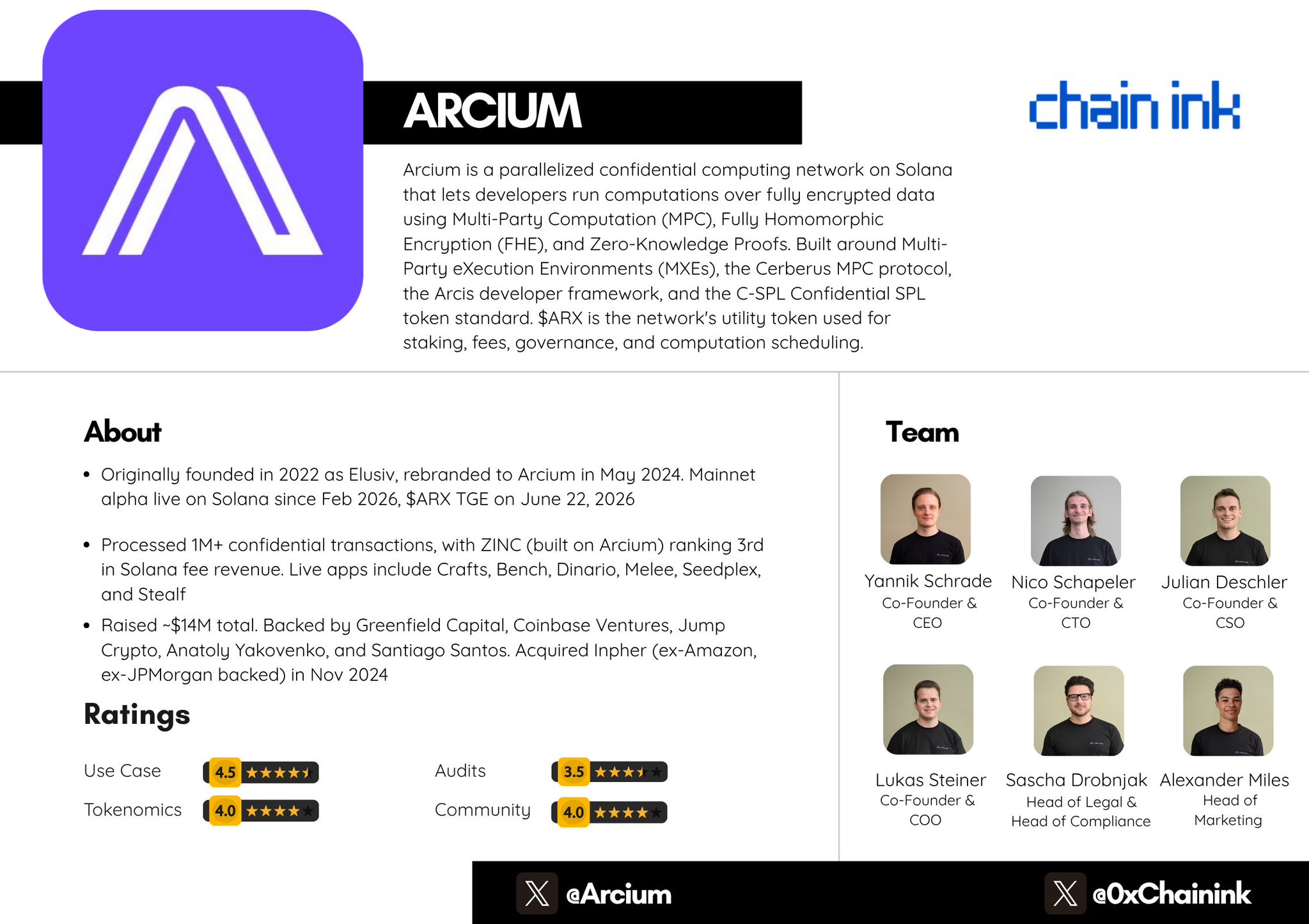 28 7 4.16K オリジナル >リリース後のARXのトレンド非常に強気Arcium is a leading confidential computing network on Solana, and the ARX token has strong fundamentals and high growth potential.
 Yeminiz 💙🫵 Educator Founder C57.27K @_yeminiz
good day mutual are you donating to @Polymarket today? cos i might do that again ☹️ https://t.co/NrbqAyBIjX
 Yeminiz 💙🫵 Educator Founder C57.27K @_yeminiz
which airdrop are you most bullish on? - base - opensea - poly market - action model - quip network - others (add in the comments) https://t.co/lekdgLwZc5
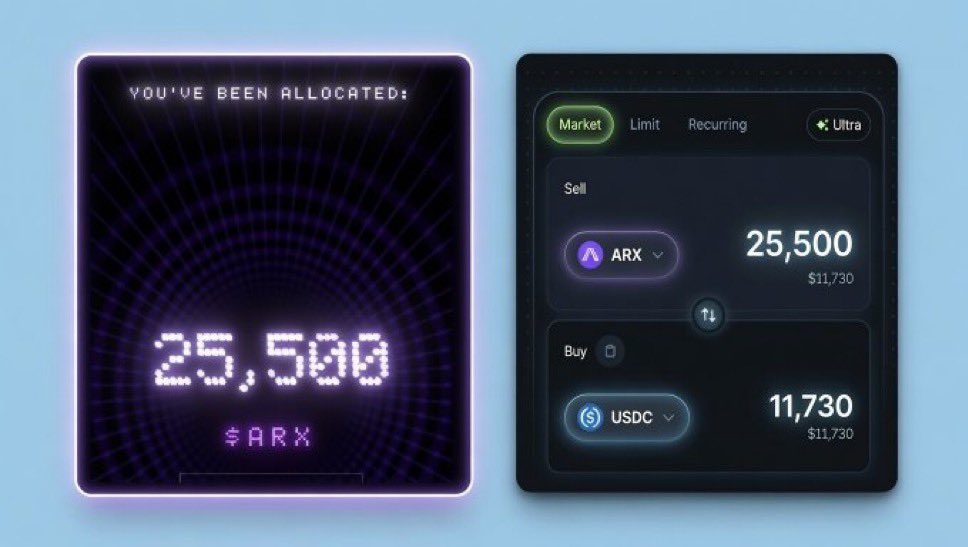 80 55 2.82K オリジナル >リリース後のARXのトレンド中立The tweet asks users which airdrop projects they are bullish on, and showcases ARX airdrop allocation and a negative experience with Polymarket.
