Rewards
Futures Daily Draw
100% Chance To Win With Daily Trades
現物の日次のドロー
Win 8,888 USDT In Grand Prizes
ステークして投票
投票してエアドロップを獲得
機関
プロなかつ専門的なサービス対応
BitMart VIP
限定報酬のロック解除
アカデミー
トレードとブロックチェーンについて
BitMart Internship
Start your Crypto Career Here
BitMart Travel
ワンストップグローバルトラベルサービス
モバイルチャージ
モバイルを簡単に、オンラインで、安全にチャージ
Send
Send money globally, fast and secure
BitMartモール
Live on crypto

Lido wstETH (WSTETH)
$ 3,339.79 (WSTETH/USD)
-0.43%
24H
Lido wstETH ライブ価格データ
Lido wstETHの今日の価格は$ 3,339.79 (WSTETH/USD)です。 時価総額$ 12.72B USD、 24時間取引量$ 8.20M USD、 24時間の価格変動-0.43%、 そして流通供給量3.81M WSTETH。
Lido wstETH WSTETH 価格履歴 USD
Lido wstETHの今日、7日間、30日間、90日間の価格を追跡
期間
24H変動幅
24H変動率 (%)
本日
$ 14.53
-0.43%
7日
$ 97.96
3.01%
30日
$ 248.69
8.02%
90日
$ 1,413.05
72.92%
WSTETHを今すぐ所有
BitMartでWSTETHを簡単に安全に売買できます。
Lido wstETH 相場情報
$ 3,337.06 24H変動幅 $ 3,391.98
過去最高値
$ 6,450.79
過去最安値
$ 894.01
24H変動幅
-0.43%
24H取引高
$ 8,199,635.44
供給量
3.80M
WSTETH
時価総額
$ 12.72B
最大供給量
--
完全希薄化後時価総額
$ 12.72B
取引 WSTETH

Lido wstETH Xインサイト

Bubbafox
Influencer
Tokenomics_Expert
B
 26.4K @bob4punk
 中立
CCIP transfers $13.1M, wstETH leads, encourages staking LINK.

CCIPMetrics D
4.1K @CCIPMetrics #CCIP today
Value transferred: $13,148,079.2
Top sent token: $wstETH @LidoFinance: $3,513,052.7 (26.7%)
Transactions: 1,820
Fees: $1,916.9
Top sender: @Predictstreet: Tx: 872 (47.9%), Fees: $1,431.8 (74.7%)
Pools open. Stake your LINK today at https://t.co/yhMFfpGi0K
 124
124
 9
9
 6.0K
6.0K
2026-07-12 00:57
リリース後のWSTETHのトレンド
中立
CCIP transfers $13.1M, wstETH leads, encourages staking LINK.

StakingCabin
OnChain_Analyst
Founder
C
2.8K @stakingcabin 強気
wstETH can be bridged to Robinhood, continuing to earn ETH staking rewards
One of the biggest challenges in DeFi is fragmented liquidity.
By enabling wstETH to move to Robinhood Chain while continuing to accrue staking rewards, capital can flow into a new ecosystem without sacrificing its underlying yield.

Lido D
228.6K @LidoFinance Staked ETH, meet Robinhood Chain.
Your wstETH can now cross over to @RobinhoodCrypto, carrying its Ethereum staking rewards with it and unlocking a new ecosystem to put it to work in.
↓ https://t.co/23u0Vlp9rE
1
0
110
2026-07-07 14:27
リリース後のWSTETHのトレンド
強気
wstETH can be bridged to Robinhood, continuing to earn ETH staking rewards

Mars_DeFi
FA_Analyst
Educator
B
26.3K @Mars_DeFi 非常に強気
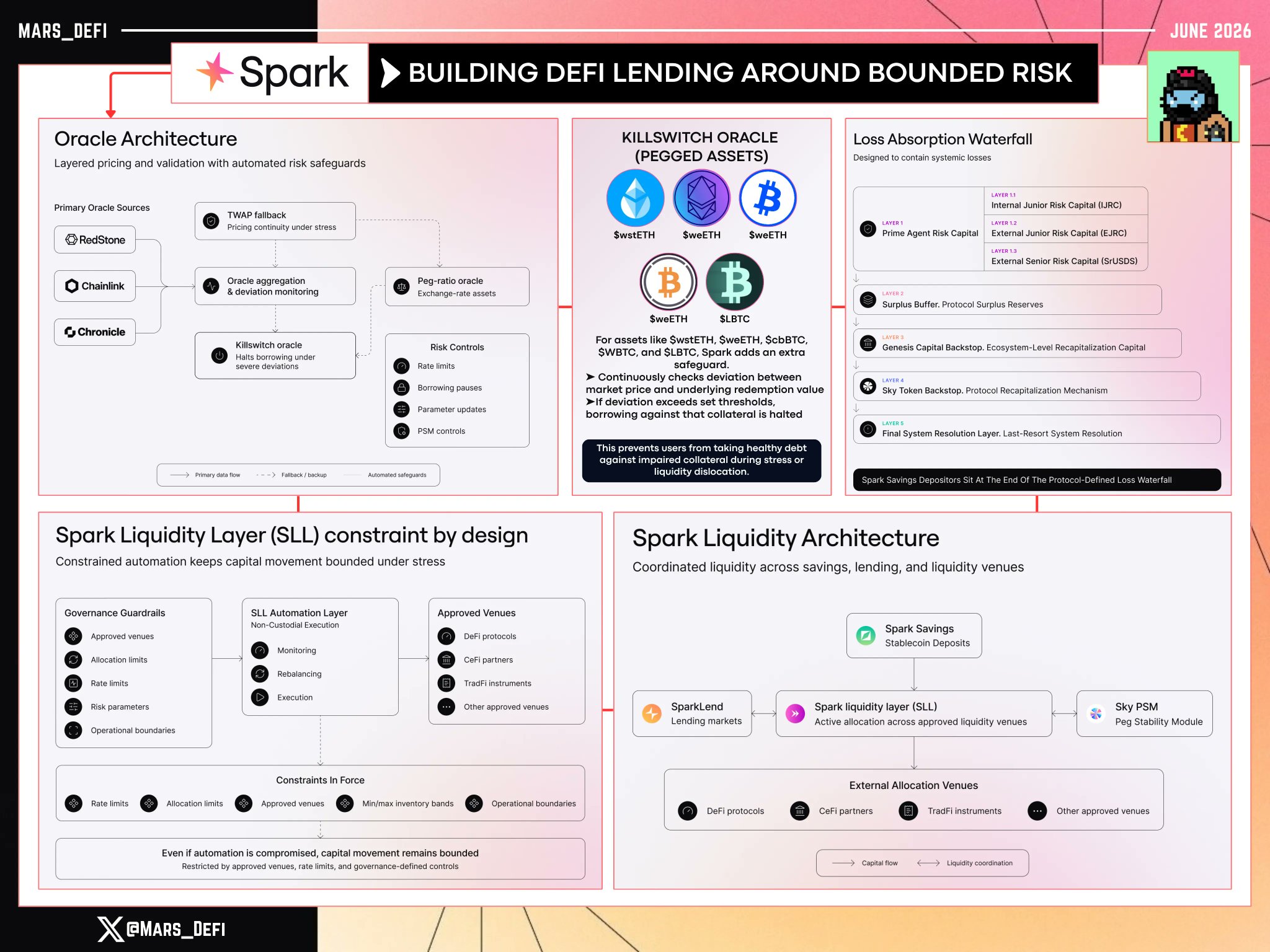
Spark builds a safe and robust DeFi lending infrastructure through multi‑layer risk control, oracles, and liquidity management.
Most lending markets optimize for liquidity and capital efficiency first, then try to manage risk after the fact while @sparkdotfi ’s security/risk framework is one of the better examples of where DeFi lending is heading.
The whole architecture is built around bounded risk, controlled capital movement, layered loss absorption, oracle redundancy, and stress-response mechanisms.
Here’s how Spark does it.
—
Spark keeps a deliberately narrow collateral set, which reduces exposure to fragmented liquidity, weak redemption assumptions, and long-tail collateral risk.
Instead of trying to list every possible asset, it prioritizes predictable liquidation behavior and deeper market structure during stress.
For assets with more unique or chain-specific risks, Spark uses isolated markets. That means risk can be priced more precisely per collateral type, and a single collateral issue does not automatically contaminate the broader pool.
—
The oracle setup is also important.
Spark uses a three-oracle median system drawing from @redstone_defi , @chainlink , and @ChronicleLabs oracle.
When all three return valid prices, the median is used. If only two valid sources are available, the average is used, with fallback logic under degraded conditions.
That reduces dependency on any single oracle provider.
For pegged or exchange-rate assets like $wstETH, $weETH, $cbBTC, $WBTC, and $LBTC, Spark adds another layer through a killswitch oracle.
• This continuously checks whether market pricing is diverging from the underlying exchange-rate or redemption value.
• If deviation passes predefined thresholds, Spark can halt new borrowing against that collateral.
That is a very important safeguard because it prevents users from borrowing healthy debt against impaired collateral during periods of stress, liquidity fragmentation, or pricing dislocation.
—
The liquidity architecture is another strong part of the design.
Spark’s Liquidity Layer is not just idle capital sitting passively in a pool. It coordinates liquidity across Spark Savings, SparkLend, the Sky PSM, and other approved venues.
But the key part is that this liquidity movement is constrained by design.
All venues must be pre‑approved by governance. Capital movement is subject to;
• allocation limits
• rate limits
• min/max inventory bands
• risk parameters
• operational boundaries
Spark’s framework is built around controlled risk, not unlimited automation.
Capital can only move through approved venues, rate limits, allocation limits, and governance‑defined boundaries. So even if automation fails, the damage is contained.
The same idea applies to losses.
Before depositors are affected, losses pass through multiple buffers: risk capital, surplus buffer, Genesis Backstop, SKY backstop, and final resolution.
Spark Savings also has 1:1 USDS backing, liquidity buffers, fast withdrawal routing, real-time transparency, Credora risk reviews, and limited bridge exposure.
—
Overall, the theme is simple:
Spark is not just chasing higher yields.
It is building DeFi credit infrastructure around constrained liquidity, layered protection, and limited blast radius.

Spark D
68.6K @sparkfinance Inside Spark’s loss absorption & risk frameworks.
Spark’s security architecture is designed around:
• bounded capital movement
• explicit loss absorption layers
• coordinated liquidity management
• multi-layered oracle systems
• constrained automation under governance-defined limits
This deep dive breaks down how Spark structures risk, liquidity, and loss absorption across Spark Savings, SparkLend, and the Spark Liquidity Layer before losses propagate toward user deposits.
Including:
• updated loss absorption waterfall
• Prime Agent risk capital
• Genesis Capital Backstop
• oracle and killswitch architecture
• programmatic liquidity coordination
• constrained allocation design under stress
Security by design.
Resilience by architecture.
See what sits between losses and user deposits: https://t.co/JQrfSxMB4z
30
18
1.7K
2026-06-03 14:12
リリース後のWSTETHのトレンド
非常に強気
Spark builds a safe and robust DeFi lending infrastructure through multi‑layer risk control, oracles, and liquidity management.
価格予測
WSTETHを購入するのに良い時期はいつですか?WSTETHは今買いでしょうか、売りでしょうか?
Lido wstETH(WSTETH)を購入または売却する適切な時期を決定する際は、まずご自身の取引戦略とリスクプロファイルに合わせることが重要です。長期投資家と短期トレーダーは市場状況を異なる方法で解釈することが多いため、決定には個人的なアプローチを反映すべきです。 最新の WSTETH 4時間テクニカル分析によると、現在の取引シグナルは 売却 です。 最新のWSTETH1日テクニカル分析によると、現在のシグナルはホールドです。

ビーコン予測
の確率的価格予測(今後24時間)ビーコン予測に関する免責事項
このページに表示されるデータ結果は、選択した取引ペアの実際の取引データ(OHLCV)と対応するテクニカル指標に基づいて分析されています。
この予測は実験的な技術的成果であり、あくまで参考目的で提供しています。これは投資アドバイスをではありません。現実世界での予期せぬ出来事が市場行動に大きな影響を与える可能性があります。トレーダーは慎重に意思決定を行うべきです。
この予測は実験的な技術的成果であり、あくまで参考目的で提供しています。これは投資アドバイスをではありません。現実世界での予期せぬ出来事が市場行動に大きな影響を与える可能性があります。トレーダーは慎重に意思決定を行うべきです。
アプリバージョン Lido wstETH
Lido wstETH (WSTETH) is a cryptocurrency launched in 2020and operates on the Ethereum platform. Lido wstETH has a current supply of 3,807,834.45169063. The last known price of Lido wstETH is 3,305.89974941 USD and is up 1.19 over the last 24 hours. It is currently trading on 798 active market(s) with $6,757,557.09 traded over the last 24 hours. More information can be found at https://www.lido.fi.
続きを読む