I’m always watching the tokenization of Real World Assets, and now the tokenized euro is quietly becoming one that has captured my attention.
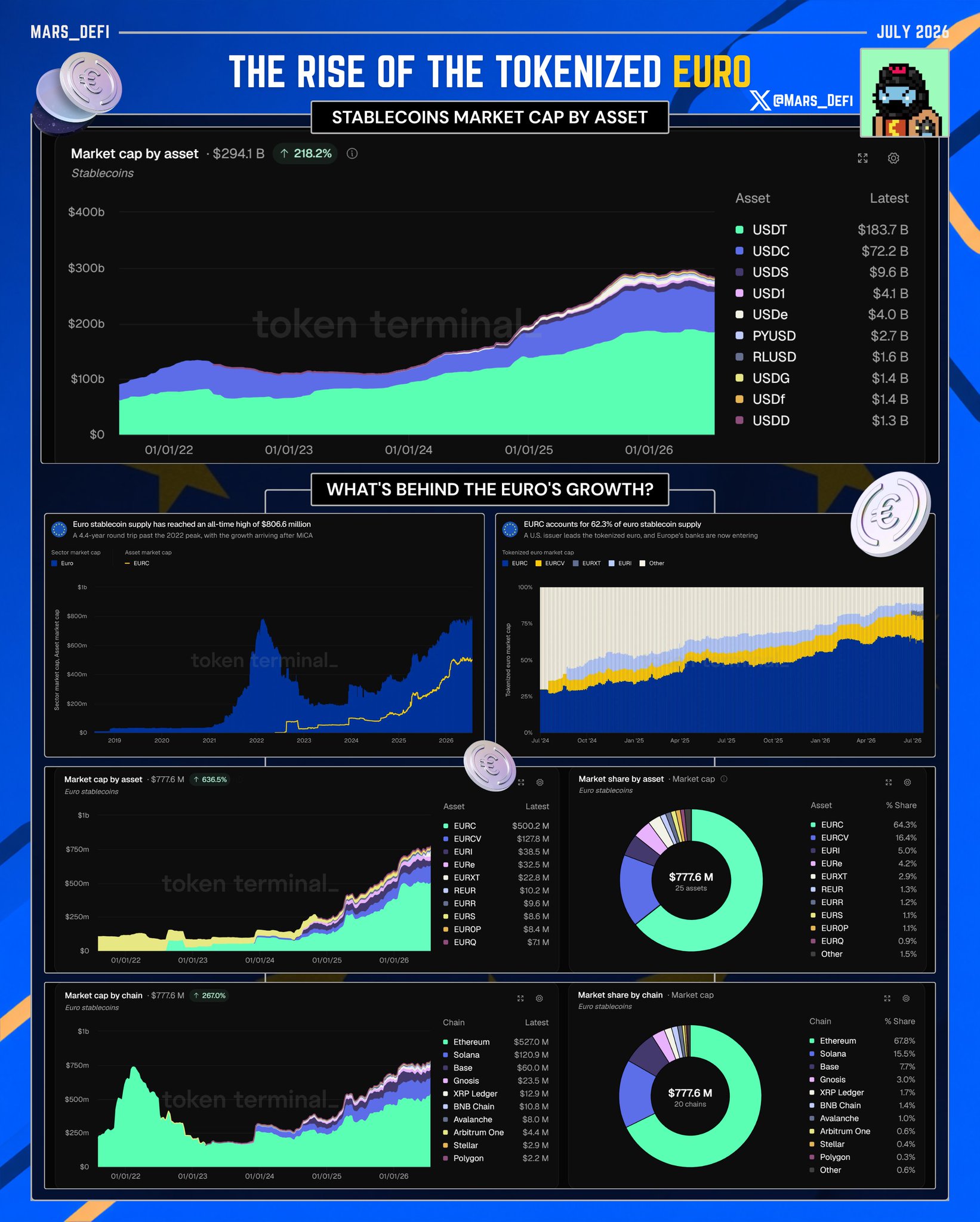
Euro stablecoin supply recently crossed an all-time high of $806.6 million and is now at $777.6M .
That represents 51.7% growth over the past year, compared with 16.8% for dollar stablecoins proving that genuine demand exists.
—
MiCA appears to have provided the regulatory clarity the market needed.
Since its stablecoin rules took effect, euro stablecoin supply has roughly tripled from $266.7 million to $806.6 million.
And yes, this is good for European crypto users.
Most Europeans still enter crypto through euros, convert into a dollar stablecoin, use DeFi, and then convert back to euros when exiting.
That introduces additional fees, FX exposure and friction and a liquid tokenized euro changes that.
—
Users can hold their native currency onchain, settle transactions around the clock, move funds across borders and participate in DeFi without first taking an unintended position on the dollar.
For European businesses, it could make onchain payroll, invoicing and supplier payments much easier.
For Europe’s tokenized-asset market, it provides a native settlement currency.
—
If European bonds, funds, deposits and equities increasingly move onchain, they need deep euro-denominated liquidity beside them. Otherwise, Europe risks tokenizing its assets only for those markets to settle primarily in digital dollars.
That is where this becomes strategically important.
Euro stablecoins can help extend the euro into global digital markets, reduce Europe’s dependence on dollar-based crypto infrastructure and create demand for euro-denominated reserve assets.
—
@circle’s EURC currently controls 62.3% of the market.
Europe created the regulatory framework, yet an American company has captured most of the resulting growth.
That isn’t necessarily bad for users as $EURC offers regulated, fully reserved, 1:1 redeemable euro exposure across multiple chains.
But strategically, Europe needs its own banks and fintech companies to compete on distribution, liquidity and DeFi integrations.
—
The tokenized euro has entered its infrastructure phase and it is becoming useful enough that European users no longer need to leave their home currency whenever they move onchain.