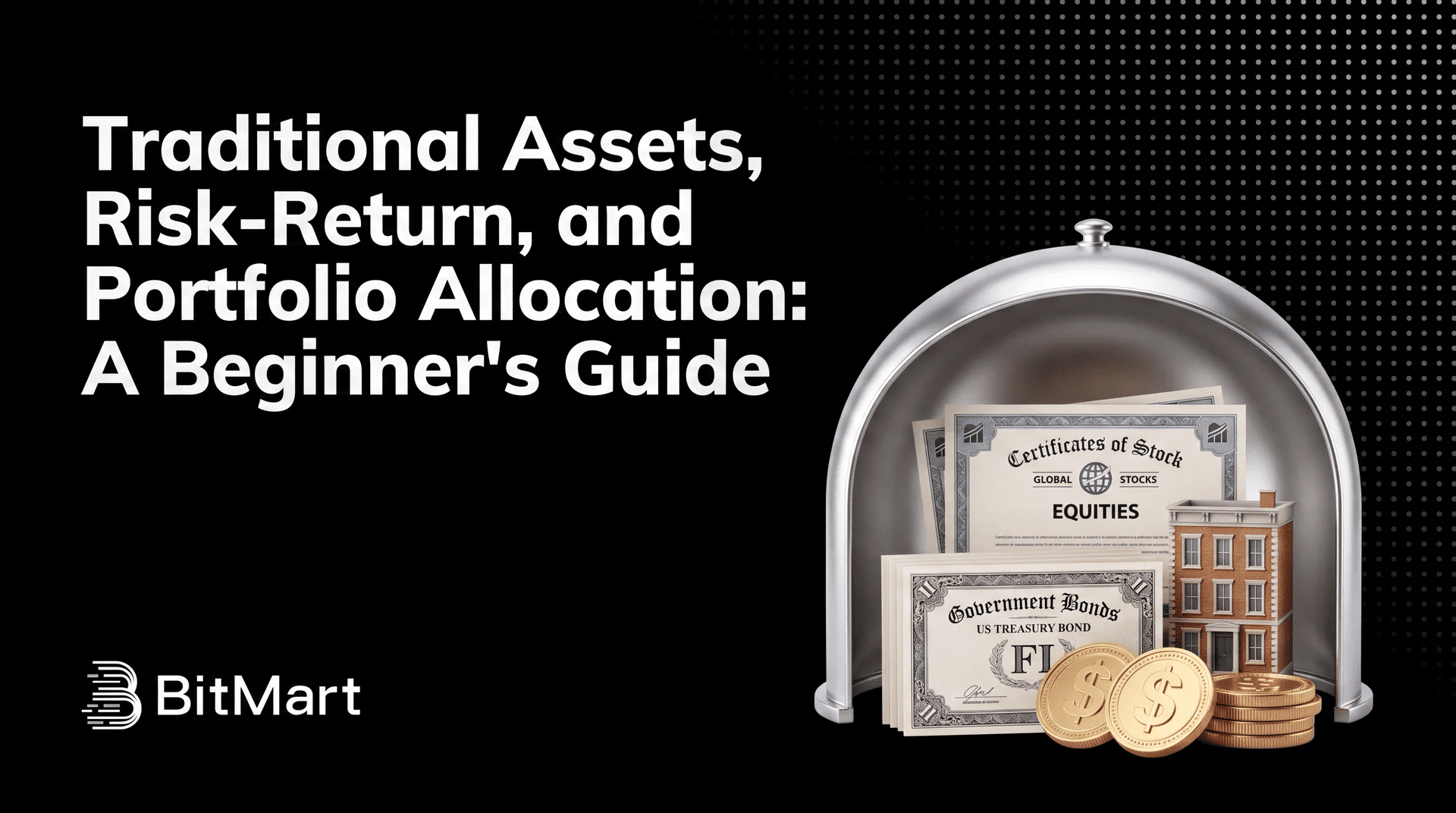
Before trading digital assets, it helps to understand what investment assets are and how they behave. The concepts that apply to stocks and bonds apply to crypto too. Risk, return, diversification, and allocation are not crypto-specific ideas. They are the foundational vocabulary of investing, and understanding them changes how you read any market.
Quick Answer: Stocks, bonds, and ETFs each sit at different points on the risk-return spectrum. Combining them in proportions that match your risk tolerance and time horizon is called asset allocation. Getting that allocation right matters more to long-term outcomes than picking individual assets. The same principles apply when you add digital assets to the mix.
Part 1: The Three Core Traditional Asset Classes
Stocks
A stock represents a fractional ownership stake in a company. When you buy shares, you participate in the company's performance: if it grows profitably, the share price tends to rise and the company may pay dividends. If it struggles, the share price falls.
Stocks sit toward the higher-risk, higher-return end of the traditional asset spectrum. Their value can move sharply based on earnings reports, industry shifts, management decisions, and broader economic conditions. Over long periods, equities have historically outperformed other traditional asset classes, but that performance comes with significant short-term volatility[1].
ThroughBitMart's markets, you can access tokenized versions of traditional stocks, which combine the price exposure of equity markets with the 24/7 accessibility of digital asset infrastructure.
Bonds
A bond is a loan. When you buy a bond issued by a government or corporation, you are lending them money for a fixed period. In return, they pay you regular interest and return the principal when the bond matures.
Because the income stream is predictable and the principal is contractually owed, bonds are generally less volatile than stocks. The tradeoff is lower return potential. They serve a different function in a portfolio: not to generate growth, but to provide income and reduce overall volatility[2].
Bond prices move inversely to interest rates. When rates rise, existing bond prices fall, because newly issued bonds offer better terms. This is worth understanding before adding bonds to any portfolio.
ETFs
An exchange-traded fund holds a collection of assets, such as a basket of stocks tracking an index, a mix of bonds, or a group of commodities. It trades on an exchange like a single stock, so you can buy or sell it throughout the trading day at market price.
ETFs offer instant diversification at a lower cost than most actively managed funds[1]. Instead of researching and buying 50 individual companies, you can buy one ETF that holds all of them. For most beginners, index-tracking ETFs covering broad markets are among the most straightforward ways to gain diversified exposure without needing to select individual securities.
Part 2: Risk and Return in Practice
What Investment Risk Actually Means
Risk in investing is the probability that your actual return falls below what you expected, up to and including losing money. It takes several forms worth distinguishing[3].
Market risk affects your entire portfolio. Recessions, interest rate shifts, inflation, and geopolitical disruptions can move prices across all asset classes simultaneously. You cannot diversify this away because it hits everything at once.
Inflation risk is subtler. If your portfolio returns 4% annually and inflation runs at 5%, you are losing purchasing power in real terms even while the nominal number looks positive.
Interest rate risk matters especially for bond holders. Rising rates reduce the value of existing bonds, so a portfolio heavily weighted toward fixed income is exposed to central bank policy decisions in a way that an equity portfolio is not.
Liquidity risk is the inability to exit a position quickly at a fair price. Large-cap stocks and major currency pairs are highly liquid. Smaller-cap assets, certain bonds, and many crypto tokens carry meaningful liquidity risk that only becomes apparent when you actually need to sell.
Diversification is the primary tool for managing risks that are specific to individual assets. It does not eliminate market-wide risk, but it prevents a single bad outcome from determining your overall results.
What Return Actually Means
Return is the total gain or loss on an investment over a period. It comes from two sources: capital appreciation, meaning the asset price went up, and income, meaning the asset paid dividends or interest while you held it.
Returns are more meaningful when expressed in annualized terms rather than absolute terms. A 30% gain sounds impressive, but whether it represents a good outcome depends on how long it took and what risk was involved. A 30% gain over 10 years is very different from a 30% gain in one month.
The Risk-Return Tradeoff
The relationship is direct: assets that can deliver higher returns require accepting higher risk of loss. This holds consistently across asset classes[4].
Government bonds in stable economies carry low default risk and offer low yields. Blue-chip equities carry more volatility but have historically delivered higher long-term returns. Growth stocks and digital assets sit further along the spectrum, with higher potential upside and larger potential drawdowns.
There is no asset that reliably offers high returns with low risk. When something appears to, that is worth examining closely. The expected return on an asset should roughly reflect the risk embedded in holding it.
Part 3: Building a Portfolio Allocation
Asset allocation is the decision about how to divide your portfolio across different asset classes. Research consistently shows that this decision has more influence on long-term returns than the specific securities you pick within each category[3].
The right allocation depends on three things: your time horizon, your financial capacity to absorb losses, and your psychological tolerance for watching your portfolio value move around.
Conservative Allocation
A conservative allocation prioritizes capital preservation over growth. It typically holds a large proportion in bonds and cash, around 70 to 80%, with a smaller equity component. This suits investors who need access to their funds within a few years or cannot absorb significant drawdowns without changing their financial plans. The tradeoff is lower growth potential over time[5].
Balanced Allocation
A balanced allocation targets a middle ground between growth and stability. The 60/40 portfolio, 60% equities and 40% bonds, has been a standard benchmark for moderate-risk investors for decades. It gives meaningful equity exposure for long-term growth while the bond component reduces overall volatility. Whether the classic 60/40 remains optimal in today's rate environment is debated, but the principle of balancing growth assets against stabilizing assets holds[5].
Growth Allocation
A growth allocation concentrates heavily in equities, often 80 to 90%, with a small defensive component. It suits investors with long time horizons, typically 10 years or more, who can hold through significant downturns without needing to access the capital. The higher equity weighting creates more volatility in the short term but has historically produced stronger long-term compounding.
Investors adding digital assets to a traditional portfolio are effectively increasing the growth and volatility profile of the overall allocation. A small crypto allocation, for example 5 to 10% of a broader portfolio, adds return potential and risk. The appropriate size depends on the same factors that determine any allocation decision: time horizon, loss tolerance, and financial goals.
You can explore the range of assets available onBitMart's spot markets to see how different instruments compare and how they might fit into a broader allocation strategy.
Frequently Asked Questions
What is the difference between a stock and a bond? A stock is an ownership stake in a company. A bond is a loan to a company or government that pays fixed interest and returns principal at maturity. Stocks carry higher risk and return potential. Bonds are more stable but offer lower returns
What is an ETF and why do beginners use them? An ETF holds a basket of assets and trades on an exchange like a stock. It provides instant diversification at low cost, which makes it a practical starting point for investors who want broad market exposure without selecting individual securities
What does asset allocation mean in practice? It means deciding what percentage of your total investment capital goes into each asset class: stocks, bonds, cash, real assets, digital assets. That percentage split has more influence on your long-term results than which specific assets you pick within each category
How should I think about adding crypto to a traditional portfolio? Treat it as a high-risk, high-return allocation within the growth portion of your portfolio. Size it relative to your overall risk tolerance. A position large enough to significantly affect your financial situation if it goes to zero is probably too large
What is the 60/40 portfolio? A portfolio split 60% equities and 40% bonds. It has been a standard benchmark for moderate-risk investors because it balances growth potential against volatility reduction. Whether it remains the optimal split in current market conditions is an ongoing debate among professional investors
.
References
1. Investopedia. "Introduction to Stocks."[1]
2. Khan Academy. "Bonds and Interest Rates."[2]
3. CFA Institute. "Risk and Return."[3]
4. Investopedia. "Risk-Return Tradeoff."[4]
5. Investopedia. "Asset Allocation."[5]
Disclaimer: Cryptocurrency investments are subject to high market risk. This article is for educational purposes only and does not constitute financial advice. Only invest funds you can afford to lose.


