Rewards
Futures Daily Draw
100% Chance To Win With Daily Trades
Spot Daily Draw
Win 8,888 USDT In Grand Prizes
Mobile Top-Up
Top up mobiles easily, online, secure
Send
Send money globally, fast and secure
BitMart Mall
Live on crypto

Neptune (XNT)
$ 0.32 (XNT/USD)
26.92%
24H
Neptune XNT Price History USD
Track the price of Neptune for today, 7 days, 30 days and 90 days
Period
Change
Change (%)
Today
$ 0.069
26.92%
7days
$ 0.15
100.00%
30days
$ 0.12
68.42%
90days
$ 0.11
60.00%
Own XNT Now
Buy and sell XNT easily and securely on BitMart.
Neptune Market Information
$ 0.25 24h Range $ 0.32
All time high
$ 5.47
All time low
$ 0.099
24h Change
26.92%
24h Vol
$ 28,830.76
Circulating supply
0.00
XNT
Market cap
$ 0
Max supply
--
Fully diluted market cap
$ 811.29K
Trade XNT

Neptune X Insight

Our Crypto Talk
Media
FA_Analyst
C
 80.2K @ourcryptotalk
 Bullish
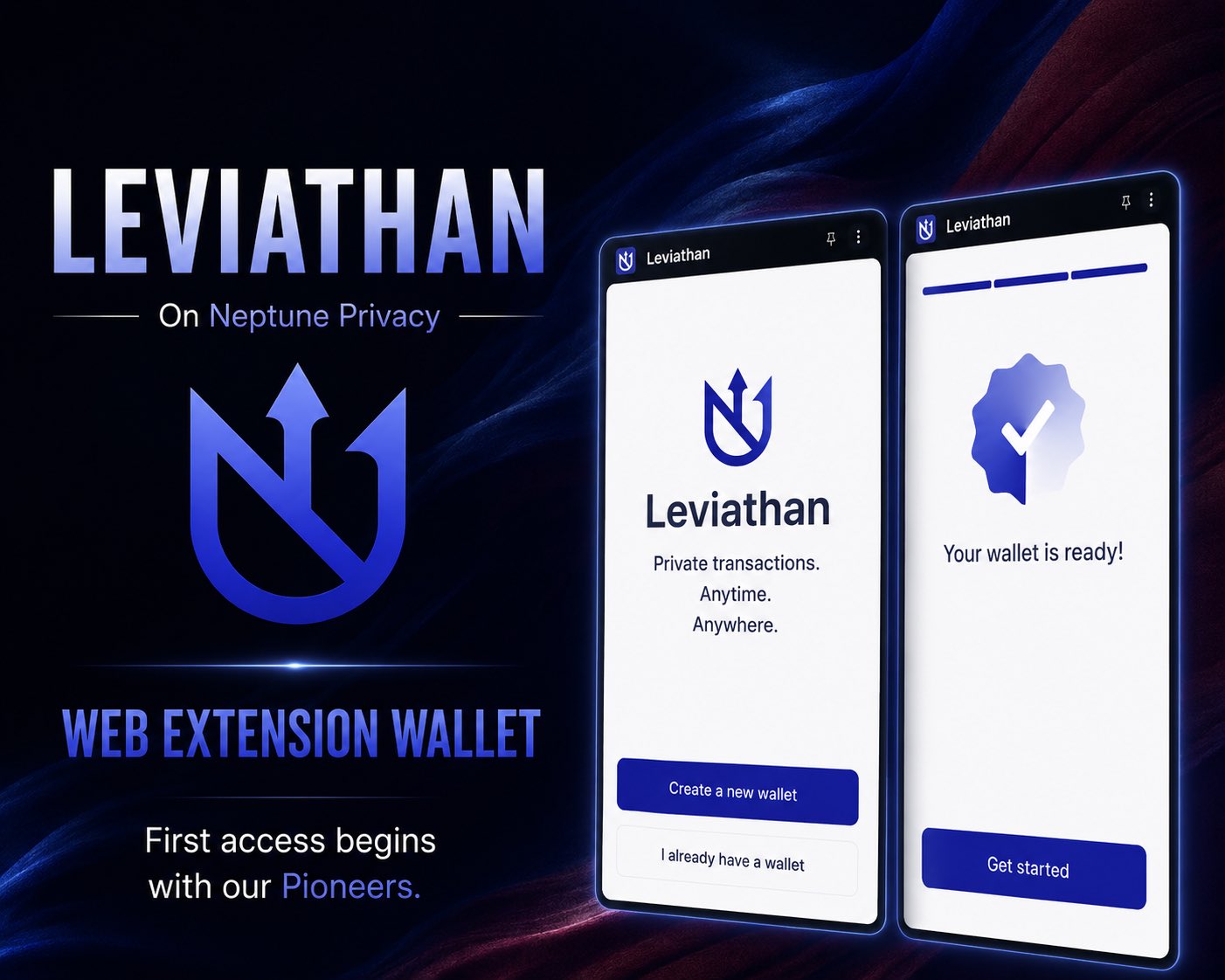
Leviathan Web Extension Wallet is about to be released, making XNT management more convenient, and pioneer users can test it first.

Neptune Privacy D
4.3K @NeptunePrivacy The Leviathan Web Extension Wallet is almost ready.
Our Pioneers will be the first to test it before public release.
Managing and storing your $XNT is about to get a whole lot easier.
And that’s not all we have coming.
Stay tuned. https://t.co/qWs2nzULmd
 41
41
 10
10
 1.7K
1.7K
2026-07-17 03:17
Trend of XNT after release
Bullish
Leviathan Web Extension Wallet is about to be released, making XNT management more convenient, and pioneer users can test it first.

OCT Gems
Media
Educator
B
12.7K @oct_gems Extremely Bullish
Neptune ($XNT) native quantum-resistant design, using zk‑STARKs and hash PoW, offers security superior to mainstream blockchains.
Most blockchains will eventually need a quantum upgrade.
$XNT was designed so it hopefully never has to.
That's because Neptune was built around a simple assumption:
Quantum computers aren't science fiction.
They're inevitable.
The problem is that most blockchains today still rely heavily on elliptic curve cryptography (ECC).
If sufficiently powerful quantum computers arrive, Shor's algorithm could theoretically derive private keys from public keys, breaking many of the cryptographic assumptions crypto relies on today.
This creates the risk of "harvest now, decrypt later."
Data collected today could potentially be broken in the future.
Neptune takes a very different approach.
Instead of building on ECC and planning upgrades later, the protocol avoids ECC-based assumptions in its core architecture.
The foundation is zk‑STARKs.
Unlike many zero-knowledge systems that rely on elliptic curves or trusted setups, STARKs are built using collision-resistant hash functions and algebraic techniques.
No trusted setup.
No toxic waste.
No elliptic curve dependency in the proof system itself.
Every transaction and smart contract execution is proven using zk‑STARKs, enabling private-by-default execution while maintaining post-quantum security assumptions.
Consensus follows a similar philosophy.
Neptune uses hash-based Proof-of-Work.
Like Bitcoin, this means quantum computers would primarily benefit from Grover's algorithm, which offers only a quadratic speedup rather than the dramatic advantages Shor's provides against ECC.
The execution environment follows the same design principles.
Triton VM and Mutator Sets operate inside this STARK-based framework without introducing hidden ECC dependencies into the core protocol.
The result is a stack where post-quantum security isn’t treated as a future upgrade.
It’s treated as a design constraint from day one.
Most projects are still asking:
"How do we migrate to post-quantum cryptography later?"
$XNT asked a different question:
"What if we built for the quantum era from the start?"
Whether quantum threats arrive in 10 years or sooner, that feels like a question more of crypto should probably be asking.
 11
2
1.3K
11
2
1.3K
2026-06-26 19:12
Trend of XNT after release
Extremely Bullish
Neptune ($XNT) native quantum-resistant design, using zk‑STARKs and hash PoW, offers security superior to mainstream blockchains.
Our Crypto Talk
Media
FA_Analyst
C
80.2K @ourcryptotalk Extremely Bullish
XNT, a post‑quantum privacy L1 built on zk‑STARKs and Mutator Sets, is seen as the next‑generation cryptocurrency with high growth potential.
$XMR and $ZEC secured today's privacy market.
$XNT is building for the next cryptographic era...
Post‑quantum cryptography from day one.
Here's what makes it different 🧵👇 https://t.co/gbOZHVuPAw

Our Crypto Talk
Media
FA_Analyst
C
80.2K @ourcryptotalk 1/ What is @NeptunePrivacy ?
A proof-of-work Layer 1 built around zk‑STARKs.
The goal:
Private transactions.
Private applications.
And cryptography designed to remain secure in a post‑quantum world.
Our Crypto Talk
Media
FA_Analyst
C
80.2K @ourcryptotalk 2/ The Core Thesis
The biggest selling point isn't privacy.
It's quantum resistance.
Most major privacy coins still rely on cryptographic assumptions that could eventually face challenges from powerful quantum computers.
$XNT was designed differently from the start.
Our Crypto Talk
Media
FA_Analyst
C
80.2K @ourcryptotalk 3/ Technology Stack
The technology stack is what makes Neptune interesting:
• zk‑STARKs
• Mutator Sets
• Triton VM
• Proof‑of‑Work
The project isn't trying to be "another Monero."
It's trying to push privacy infrastructure further.
Our Crypto Talk
Media
FA_Analyst
C
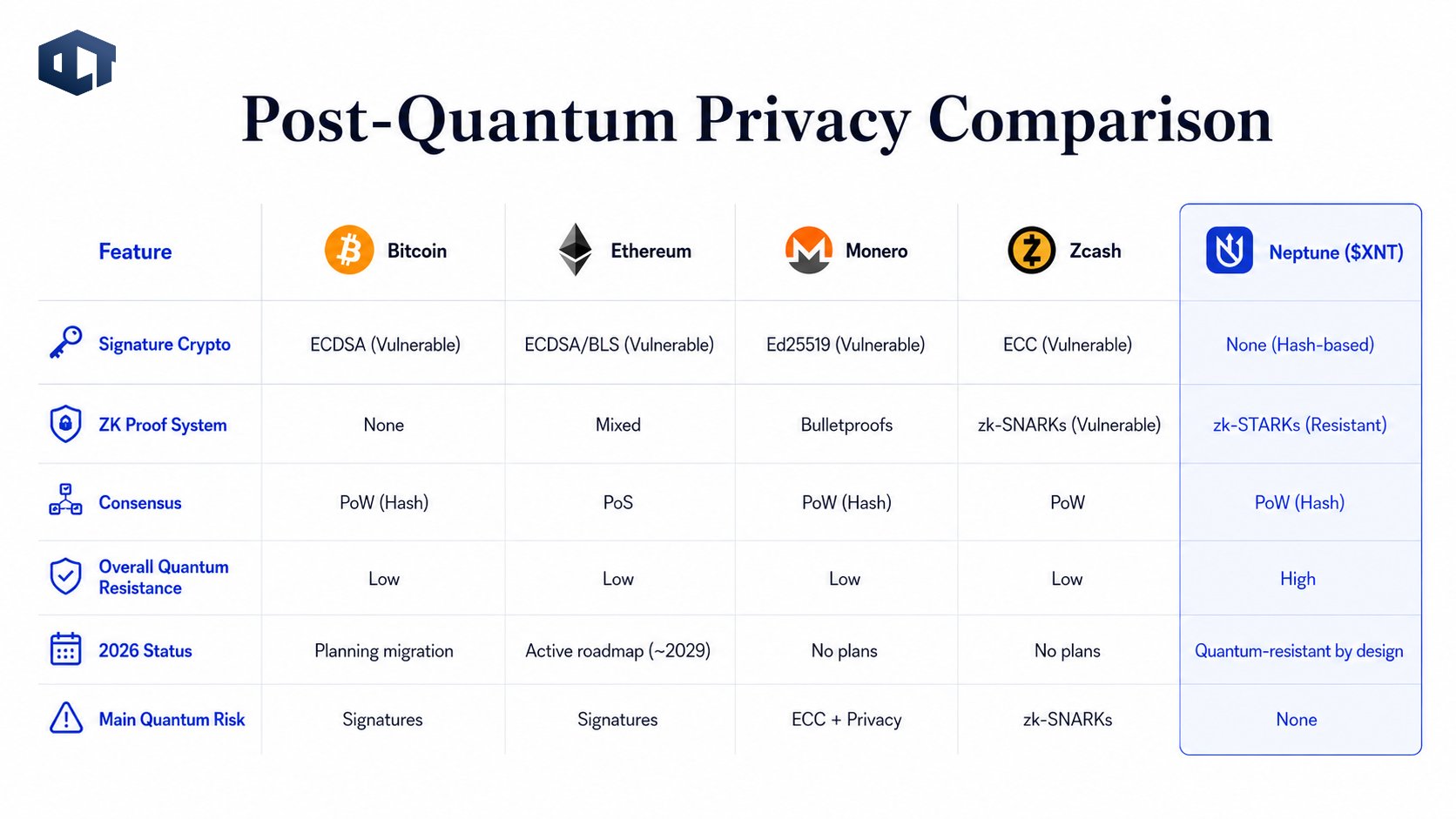
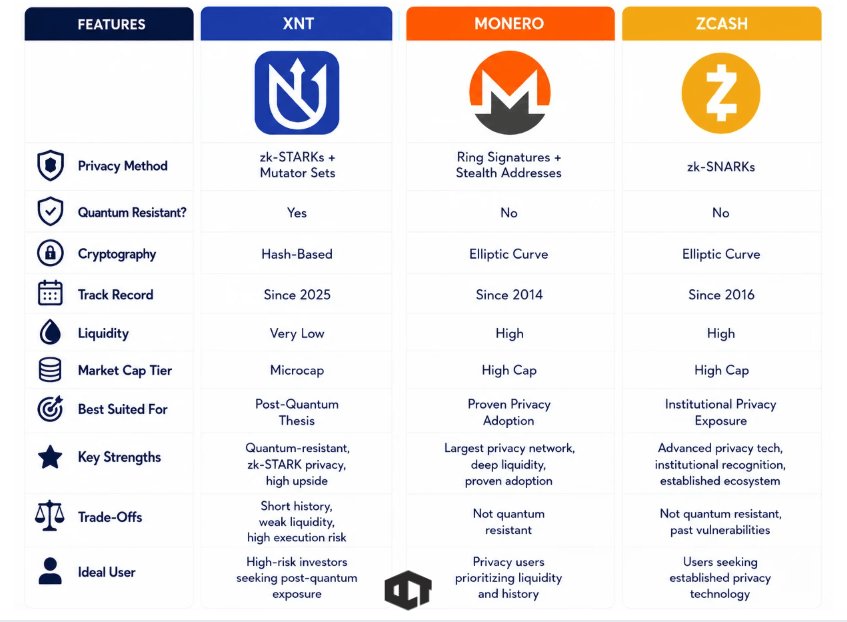
80.2K @ourcryptotalk 4/ Monero & Zcash vs Neptune
Monero relies on ring signatures, stealth addresses, and Bulletproofs.
Zcash brought zero-knowledge privacy with zk-SNARKs.
Neptune takes a different approach, using zk-STARKs to verify transactions without exposing the underlying data. https://t.co/Qr0qqRUFDl
Our Crypto Talk
Media
FA_Analyst
C
80.2K @ourcryptotalk 5/ What Are Mutator Sets?
One of Neptune's most unique innovations is Mutator Sets.
Privacy systems often become less efficient as transaction history grows.
Mutator Sets help maintain compact proofs without requiring users to scan the entire chain.
The result is stronger scalability while preserving privacy.
Our Crypto Talk
Media
FA_Analyst
C
80.2K @ourcryptotalk 6/ Tokenomics
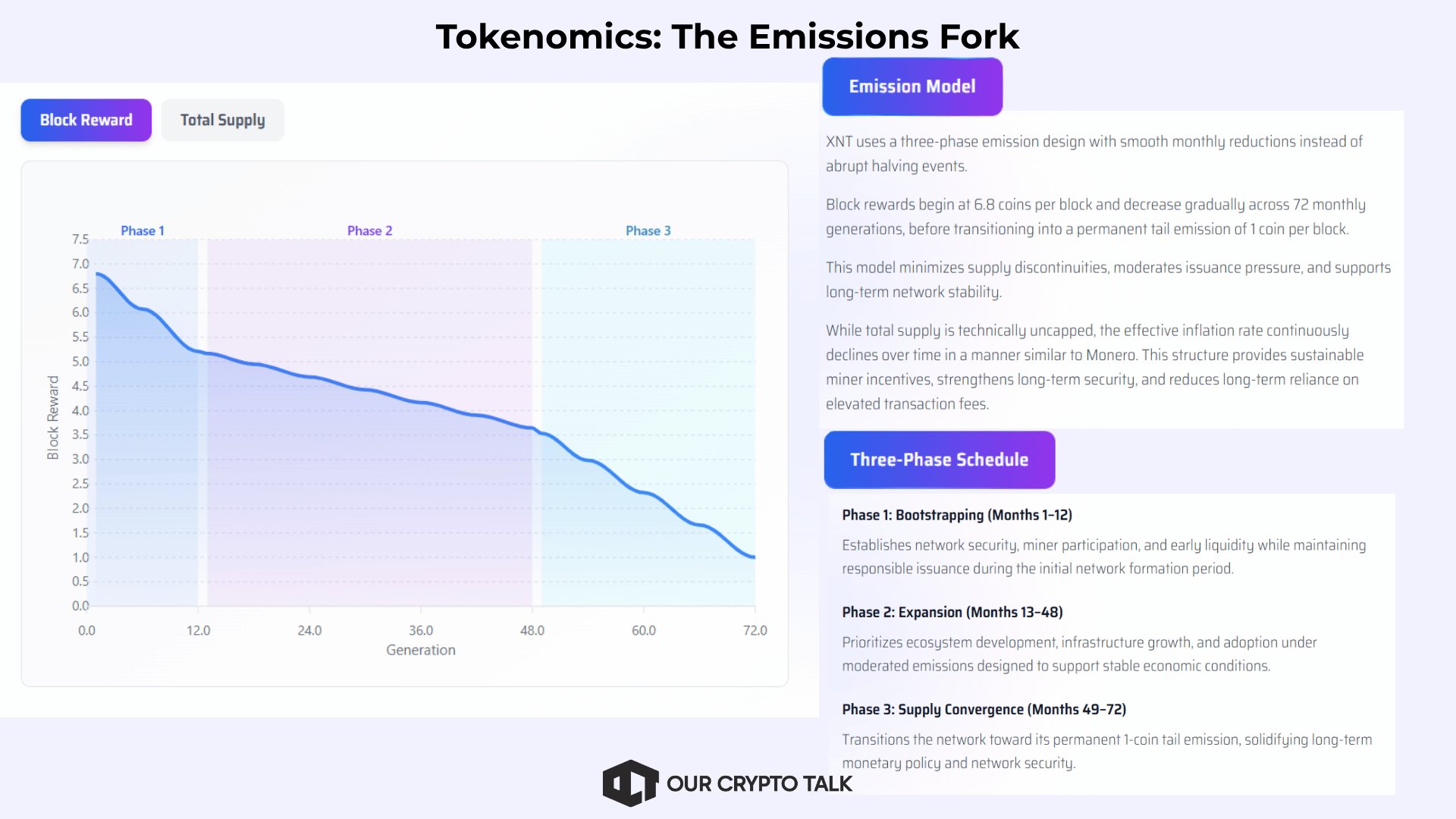
Neptune launched with 1,942,384 $XNT.
Rewards start at 6.8 XNT per block and decline over 72 monthly generations.
Afterward, the network adopts a permanent tail emission of 1 XNT per block.
All new coins are distributed through mining. https://t.co/t7j4kkgp04
Our Crypto Talk
Media
FA_Analyst
C
80.2K @ourcryptotalk 7/ Bull Case:
The bull case is straightforward.
If privacy becomes more important and quantum‑resistant cryptography becomes a major narrative, Neptune is positioned far ahead of most competitors.
That's the bet. NFA.
Our Crypto Talk
Media
FA_Analyst
C
80.2K @ourcryptotalk 8/ Want The Full Deep Dive?
This thread only scratches the surface.
If you want a deeper look at $XNT, we've already published a full review covering the technology, vision, and ecosystem.
Read the full review here:
https://t.co/q2ymJXS5LV
Our Crypto Talk
Media
FA_Analyst
C
80.2K @ourcryptotalk 9/ Final Take
$XNT isn't trying to be another Monero or Zcash. It is taking a different path to privacy.
It's building private‑by‑default digital cash and applications for a post‑quantum future.
What do you think about post‑quantum privacy? 👇
13
2
671
2026-06-12 10:37
Trend of XNT after release
Extremely Bullish
XNT, a post‑quantum privacy L1 built on zk‑STARKs and Mutator Sets, is seen as the next‑generation cryptocurrency with high growth potential.
Price Prediction
When is a good time to buy XNT? Should I buy or sell XNT now?
When deciding whether it’s a good time to buy or sell Neptune (XNT), it’s important to first align with your own trading strategy and risk profile.Long-term investors and short-term traders often interpret market conditions differently, so your decision should reflect your personal approach. According to the latest XNT 4-hour technical analysis, the current trading signal is Hold. According to the latest XNT 1-day technical analysis, the current signal is Sell.

Beacon Prediction
Probabilistic Price Forecast (Next 24 Hours)Beacon Prediction Disclaimer
The data results displayed on this page are analyzed based on actual trading data (OHLCV) of the selected trading pair along with corresponding technical indicators.
This prediction is an experimental technical product and is provided for reference purposes only. It does not constitute investment advice. Unexpected real-world events may significantly impact market behavior. Traders should make decisions with caution.
This prediction is an experimental technical product and is provided for reference purposes only. It does not constitute investment advice. Unexpected real-world events may significantly impact market behavior. Traders should make decisions with caution.
About Neptune
Neptune (XNT) is a cryptocurrency launched in 2025. Neptune has a current supply of 2,459,403 with 0 in circulation. The last known price of Neptune is 0.16092625 USD and is down -0.39 over the last 24 hours. It is currently trading on 3 active market(s) with $15,934.18 traded over the last 24 hours. More information can be found at https://neptune.io.
Read More